
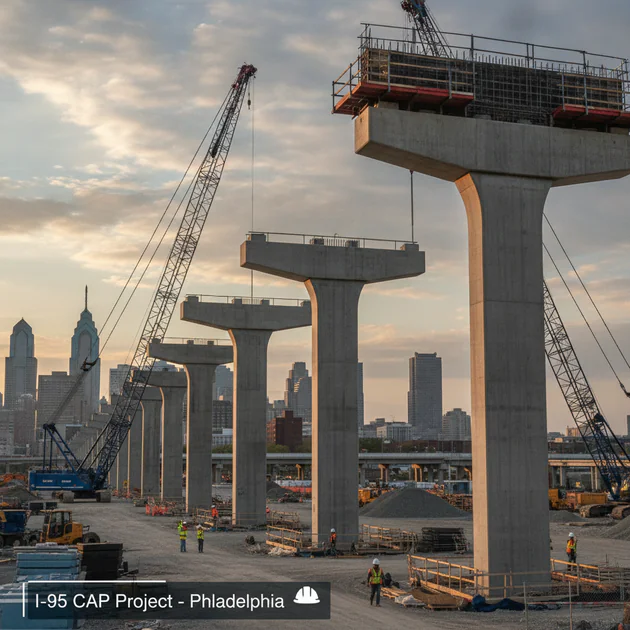
As the Philadelphia skyline continues to evolve, few projects capture the city’s ambition quite like the I-95 CAP project at Penn’s Landing. For decades, the interstate has been a concrete scar, separating the city’s historic heart from its greatest natural asset, the Delaware River. Now, with each passing season, we move closer to healing that scar. The latest significant leap forward comes with the spring 2026 update: the successful installation of a series of massive, foundational concrete piers. This isn’t just a routine construction update; it’s the symbolic and literal underpinning of a new era for Philadelphia’s waterfront and a testament to the skill of our local trade professionals.
This achievement marks a critical turning point in the project’s timeline, transitioning from subterranean and preparatory work to the vertical construction that will soon support the future park and public spaces. For professionals in Philadelphia’s construction, engineering, and trade sectors, this development is more than just news—it’s a signal of immense opportunity, a showcase of modern engineering techniques, and a harbinger of the next wave of work to come. Understanding the intricacies of this milestone is crucial for anyone invested in the physical and economic landscape of our city.
At Philadelphia Trade Experts, we are committed to providing our industry partners with in-depth analysis that goes beyond the headlines. In this comprehensive overview, we will dissect the latest I-95 CAP project concrete piers update, exploring the engineering significance of these structures, the methods behind their successful installation, and the direct implications for Philadelphia’s skilled labor market and supply chain. This is the foundation not just for a park, but for future growth and opportunity across our industry.
The I-95 CAP Project: A Refresher on a Transformative Vision
Before diving into the technical specifics of the new concrete piers, it’s essential to contextualize their importance within the grander vision of the I-95 CAP project. Officially known as the “Park at Penn’s Landing,” this multi-phase, billion-dollar infrastructure initiative is one of the most complex and transformative public works projects in Philadelphia’s modern history. Its primary goal is to build an 11.5-acre park and civic space over a section of I-95 and Columbus Boulevard, effectively creating a seamless, pedestrian-friendly connection between Old City and the Delaware River waterfront.
The concept of “capping” an interstate is a sophisticated engineering feat. It involves constructing a massive lid or deck over the highway, which then serves as the ground level for new developments, such as parks, buildings, and roadways. The I-95 CAP will not only provide much-needed green space but also facilitate new development opportunities, improve multimodal transportation, and create a world-class destination for residents and tourists alike. The project is a collaborative effort led by the Pennsylvania Department of Transportation (PennDOT), in partnership with the City of Philadelphia and the Delaware River Waterfront Corporation (DRWC), with funding from a combination of federal, state, and private sources.
The project is being executed in several distinct phases. Early phases involved utility relocation, interchange reconstruction at Chestnut and Market Streets, and extensive preparatory groundwork. The current phase, which includes the pier installation, is arguably the most critical. It lays the structural foundation upon which the entire “cap” will rest. Without the successful, precise, and durable installation of these piers, the vision for a vibrant, connected waterfront would remain just a blueprint. This work sets the stage for the subsequent placement of steel girders and precast concrete deck panels that will form the surface of the new park, bridging the gap that has defined this part of the city for over 50 years.
Deep Dive: The Critical Role of Concrete Piers in the CAP’s Foundation
To the casual observer, the newly installed rows of thick, grey columns might seem unremarkable. But for engineers and construction professionals, these concrete piers are the unsung heroes of the I-95 CAP project. They are the load-bearing backbone, designed to support immense weight and withstand environmental stressors for the next century and beyond. Their function is multifaceted and absolutely critical to the project’s long-term success and safety.
The primary function of these piers is to transfer the massive “dead loads” (the weight of the cap structure, soil, trees, and buildings) and “live loads” (pedestrians, vehicles, event equipment, and even snow) from the park deck down through the complex soil layers to the stable bedrock deep beneath the surface. Given their location adjacent to the Delaware River and over an active eight-lane interstate, the engineering challenges were immense. The design had to account for everything from soil liquefaction potential to vibrations from the 150,000+ vehicles passing through the corridor daily.
The materials science behind these piers is a showcase of modern concrete technology. The specification called for a high-performance, 8,000 PSI (pounds per square inch) self-consolidating concrete mix. This is significantly stronger than standard commercial concrete (typically 3,000-4,000 PSI). The mix includes specialized admixtures to enhance its properties:
- Corrosion Inhibitors: To protect the internal steel rebar from moisture and de-icing salts that can seep down from the surface, ensuring long-term structural integrity.
- Plasticizers: To increase the concrete’s flowability, allowing it to fill the complex rebar cages completely without voids or honeycombing, which is crucial for achieving maximum strength.
- Air-Entraining Agents: To create microscopic air bubbles that provide space for water to expand when it freezes, preventing cracking and spalling during Philadelphia’s freeze-thaw cycles.
Sourced from local ready-mix plants, the consistent quality control of this specialized concrete was a major logistical component of the project. Each pier is, in essence, a high-strength, engineered element designed for a 100-year service life. Their successful installation ensures that the ambitious vision for the park above has a foundation that is, quite literally, rock solid.
The Spring 2026 Milestone: Analyzing the Successful Pier Installation
The completion of the primary set of 72 concrete support piers ahead of the summer 2026 construction season represents a monumental achievement for the project team. This phase of the I-95 CAP project concrete piers update was a masterclass in logistics, precision engineering, and skilled labor, executed within the tight confines of an active transportation corridor. The process, from initial drilling to final curing, followed a meticulous sequence designed to maximize safety and efficiency while minimizing public disruption.
The installation process for each pier was a multi-step operation that took several days to complete. Here is a breakdown of the key stages involved:
- Site Preparation and Precision Surveying: Before any drilling began, survey crews used advanced GPS and laser-guided equipment to stake out the exact location of each pier to within a fraction of an inch. This precision was non-negotiable, as the subsequent steel beams must align perfectly.
- Drilled Shaft (Caisson) Excavation: Large-diameter, powerful drilling rigs were brought in to excavate shafts deep into the ground, often reaching depths of over 80 feet to hit stable bedrock. A steel casing or polymer slurry was used to stabilize the shaft walls and prevent collapse during excavation, especially given the challenging soil conditions near the river.
- Reinforcing Steel Cage Fabrication and Placement: Intricate cages of high-strength steel rebar, some weighing over 30 tons, were fabricated on-site or nearby. These cages were then carefully lifted by high-capacity cranes and lowered into the drilled shafts. The rebar provides the tensile strength that concrete lacks, allowing the piers to resist bending and stretching forces.
- High-Volume Concrete Pouring: The high-performance concrete was pumped into the shafts from the bottom up using a tremie pipe. This method displaces water and slurry without creating air pockets, ensuring a monolithic, void-free structure. Each pour was a continuous operation, sometimes lasting for hours, requiring a coordinated fleet of concrete trucks.
- Curing and Quality Assurance: After pouring, the concrete was left to cure, a chemical process where it hardens and gains strength. This process was carefully monitored. Test cylinders were taken from each batch and subjected to rigorous compression testing in a lab to verify that the concrete met or exceeded the 8,000 PSI strength requirement.
According to a senior project engineer on site, “The logistical dance of scheduling nightly lane closures on I-95, coordinating dozens of concrete trucks, and operating heavy machinery in such a tight space was the biggest challenge. Completing this phase safely and on schedule is a huge credit to the skill of the operators, ironworkers, and concrete finishers on this job. They are the ones building this legacy.” This successful execution not only keeps the overall project on track but also builds significant positive momentum as the work becomes more visible to the public in the coming months.
Implications for Philadelphia’s Trade Professionals and Supply Chain
A milestone like the completed pier installation is more than just a technical achievement; it’s a powerful economic engine for the Philadelphia region’s construction industry. This phase of the I-95 CAP project has already created hundreds of high-paying jobs for skilled trade professionals and generated significant revenue for local suppliers. As the project moves forward, these opportunities are set to expand, making it a critical focal point for local talent and businesses.
The demand for specialized labor has been immense. This phase required:
- Heavy Equipment Operators: Highly skilled operators for the massive drill rigs, cranes, and concrete pumps were essential. Proficiency with modern, GPS-guided machinery was a key requirement.
- Ironworkers: The complex fabrication and precise placement of the massive rebar cages demanded experienced Local 401 ironworkers with expertise in heavy reinforcing steel.
- Concrete Finishers and Laborers: Teams of dedicated laborers and finishers were needed to manage the high-volume concrete pours, ensuring proper consolidation and finishing.
- Project Managers and Safety Professionals: Coordinating the complex logistics and enforcing stringent safety protocols in a high-traffic environment required top-tier management and safety oversight.
Looking ahead, the next phases—which will involve setting structural steel beams, installing precast deck panels, and pouring the final concrete deck—will require a similar, if not greater, level of skilled labor. This presents a massive opportunity for Philadelphia’s union trades and contractors. For professionals looking to get involved, having up-to-date certifications, particularly OSHA 30, rigging, and signaling qualifications, is paramount.
The impact on the local supply chain is equally significant. The demand for thousands of cubic yards of high-performance concrete has been a boon for regional ready-mix suppliers. Similarly, steel fabricators, rebar suppliers, and heavy equipment rental companies have seen a surge in business directly tied to the project. As the project transitions to building the park itself, new opportunities will arise for landscapers, electricians, plumbers, and specialty contractors. For local businesses, positioning themselves now to meet the project’s future procurement needs is a strategic imperative. This project underscores the deep, interconnected ecosystem of our local construction economy, where a single milestone can create a positive ripple effect across dozens of sectors.
Frequently Asked Questions (FAQ)
What specific type of concrete was used for the I-95 CAP piers?
The project specifications required a highly durable and high-strength material. The piers were constructed using an 8,000 PSI self-consolidating concrete (SCC) mix. This advanced mix was engineered with specific admixtures to ensure longevity and performance in a challenging urban and riverside environment. These included a corrosion inhibitor to protect the internal steel reinforcement, superplasticizers for enhanced flow and consolidation, and an air-entraining agent to resist damage from Philadelphia’s frequent freeze-thaw cycles. The sourcing was localized to ensure consistency and support the regional economy.
How does this pier installation impact I-95 traffic in the short term?
PennDOT and its contractors have meticulously planned construction to minimize disruption to the 150,000+ vehicles that use this section of I-95 daily. The majority of the disruptive work, such as crane operations for lifting rebar cages and the setup for large concrete pours, was conducted during overnight hours and on weekends, requiring temporary lane closures. While some daytime shoulder closures have been necessary for material staging, the project has been engineered to maintain traffic flow during peak commuting hours. Motorists are advised to stay updated via PennDOT’s project website and local traffic advisories for the latest information on closures.
What are the next major construction milestones after the piers are complete?
With the foundational piers now in place, the project will move into its most visually dramatic phases. The next major milestone will be the installation of massive structural steel girders that will span between the piers, directly over the interstate. These girders will form the primary skeleton of the cap. Following the steel installation, crews will begin placing large, precast concrete deck panels on top of the girders. Finally, a cast-in-place concrete topping slab will be poured over the panels, creating the solid, continuous surface that will eventually become the base for the park’s soil, landscaping, and amenities.
How can local contractors and skilled tradespeople get involved in future phases of the I-95 CAP project?
Opportunities for involvement in this landmark project will continue for several years. Local contractors and subcontractors should regularly monitor procurement and bidding opportunities posted on the PennDOT Engineering and Construction Management System (ECMS). Networking with the prime contractors already on the project is also a key strategy. For individual skilled tradespeople, the primary pathway is through the local union halls, such as the Ironworkers, Operating Engineers, and Laborers’ unions, which are key suppliers of skilled labor for the project. Ensuring all safety certifications (like OSHA 30) and trade-specific qualifications are current is essential for being considered for work on a high-profile federal and state-funded project.
Conclusion: Building the Foundation for a More Connected Philadelphia
The Spring 2026 completion of the foundational concrete piers for the I-95 CAP project is far more than a checkmark on a construction schedule. It is a tangible, powerful symbol of progress, representing the solid base upon which a more connected, vibrant, and accessible Philadelphia is being built. This I-95 CAP project concrete piers update confirms that the ambitious vision of reuniting the city with its waterfront is firmly on track, driven by world-class engineering and the unparalleled skill of our local workforce.
For the professionals who make up Philadelphia’s construction industry, this milestone serves as both a showcase of achievement and a call to action. The techniques, materials, and logistical strategies employed here set a new standard for urban infrastructure projects. The opportunities generated, from skilled labor demand to supply chain engagement, will continue to ripple through our economy for years to come. Staying informed and prepared is the key to capitalizing on the next phases of this and other transformative projects shaping our region.
For Philadelphia’s construction professionals looking to stay ahead of major projects like the I-95 CAP, connect with Philadelphia Trade Experts. We provide the market intelligence, skilled talent, and industry connections you need to build the future of our city. Contact us today to learn how we can help you lay the foundation for your own success.
Leave a Reply