
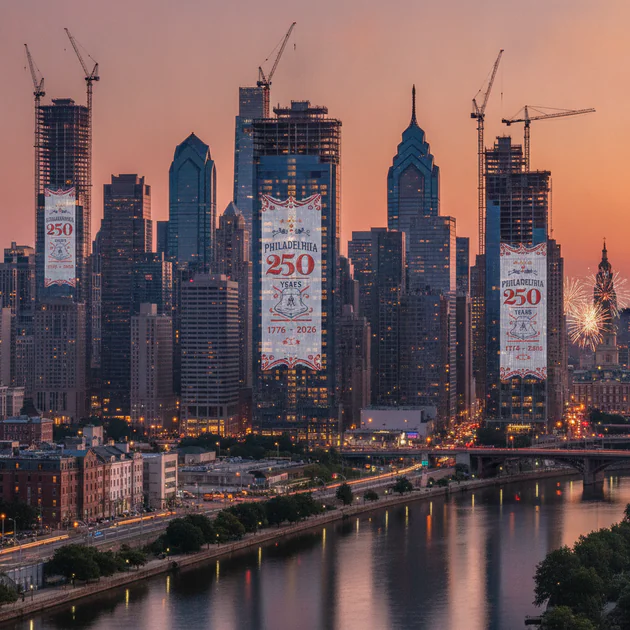
Walk through the streets of Philadelphia today, and the energy is palpable. It’s in the rhythmic clang of steel beams being hoisted into the sky, the persistent hum of heavy machinery reshaping the waterfront, and the sight of scaffolding climbing the facades of historic buildings. This is more than just business as usual; this is a city in the midst of a profound transformation. Philadelphia is on the clock, racing towards a monumental deadline: July 4, 2026, the 250th anniversary of the United States, with our city as the nation’s centerpiece.
This upcoming Semiquincentennial, officially branded as America250, is the primary catalyst for the Philadelphia 250th anniversary construction boom, a period of intense development and revitalization not seen in generations. Coupled with the global spotlight of hosting FIFA World Cup matches in the same year, the city is experiencing an unprecedented convergence of investment, ambition, and opportunity. For construction professionals—from general contractors and project managers to skilled tradespeople and suppliers—this era represents a historic chance to not only secure significant projects but also to leave a lasting mark on the city’s landscape.
However, this boom is not without its complexities. Navigating the landscape requires more than just technical skill; it demands deep local knowledge, strategic foresight, and an understanding of the unique forces at play. This comprehensive guide from Philadelphia Trade Experts will delve into the key drivers of this boom, spotlight the landmark projects defining our skyline, analyze the critical challenges of labor and supply chains, and identify the strategic opportunities for your firm to thrive. This is your blueprint for success in Philadelphia’s new golden age of construction.
The Perfect Storm: Key Drivers Fueling Philadelphia’s Construction Surge
The current construction boom isn’t the result of a single event but a powerful confluence of factors creating a “perfect storm” of demand. Understanding these drivers is crucial for any firm looking to align its strategy with the city’s long-term vision. Three primary catalysts are working in concert to reshape Philadelphia’s built environment.
First and foremost is the America250 celebration. As the birthplace of the nation, Philadelphia will be the epicenter of the country’s 250th anniversary. This isn’t just about a parade and fireworks; it’s a multi-year initiative driving massive public and private investment into projects that enhance the visitor experience and create a lasting legacy. This includes large-scale infrastructure overhauls, the revitalization of historic sites, the creation of new public parks and plazas, and the beautification of key corridors. The political will and funding behind these projects are immense, creating a powerful engine for the construction sector.
The second major driver is the FIFA World Cup 2026. Being selected as a host city is a game-changer, bringing a global audience and demanding world-class facilities. This goes far beyond upgrades to Lincoln Financial Field. The city needs to expand its hospitality infrastructure, including new hotel construction and existing property renovations. Transportation networks, from Philadelphia International Airport (PHL) to SEPTA’s regional rail and subway lines, require significant upgrades to handle the influx of visitors. This international event provides a hard deadline and a global stage, accelerating timelines and raising the stakes for every project involved.
Finally, these landmark events are amplified by powerful underlying economic trends. A robust post-pandemic economic recovery, bolstered by federal initiatives like the Bipartisan Infrastructure Law, is injecting billions of dollars into “shovel-ready” projects. Simultaneously, Philadelphia’s emergence as a global hub for life sciences and biotechnology—often dubbed “Cellicon Valley”—is fueling a parallel boom in highly specialized construction. The demand for state-of-the-art laboratory spaces, research facilities, and biomanufacturing plants in areas like University City and the Navy Yard adds another deep layer of opportunity, independent of but concurrent with the 2026 festivities.
Mapping the Boom: Landmark Projects and Key Sectors
The Philadelphia 250th anniversary construction boom is not a monolithic event; it’s a mosaic of diverse projects across multiple sectors. From foundational infrastructure to gleaming new skyscrapers, the work is transforming every corner of the city. Here’s a breakdown of the key areas and signature projects that construction professionals should be watching.
Infrastructure and Transportation Overhaul
Moving millions of residents and visitors efficiently and safely is the backbone of the 2026 preparations. Consequently, infrastructure is receiving a massive infusion of capital.
- The I-95 CAP Project at Penn’s Landing: Perhaps the most transformative project, this multi-hundred-million-dollar initiative will create an 11.5-acre park and civic space by capping a section of Interstate 95. It will reconnect the city to its waterfront, creating a new landmark destination and spurring adjacent development.
- SEPTA System-Wide Improvements: The transit authority is undertaking major initiatives, including the ambitious Trolley Modernization Program, station accessibility upgrades across the system, and advancing the proposed King of Prussia Rail extension. These projects involve extensive track work, station construction, and systems integration.
- Philadelphia International Airport (PHL) Expansion: To welcome the world, PHL is undergoing significant upgrades, including terminal renovations, airfield improvements, and the development of new cargo facilities to support the region’s logistics and life sciences industries.
Hospitality, Tourism, and Public Spaces
To prepare for the influx of tourists, the city is investing heavily in its public-facing amenities, creating a more vibrant and welcoming environment.
- Hotel Development: A wave of new hotel construction and major renovations is underway, particularly in Center City and near the sports complex, to increase room capacity and offer modern accommodations for World Cup and America250 visitors.
- FDR Park Master Plan: This long-term vision for one of the city’s largest parks is seeing accelerated implementation, with projects focused on habitat restoration, new athletic fields, and improved public access—all crucial for a city hosting international sporting events.
- Museum and Cultural Institution Upgrades: Major institutions are renovating and expanding. This includes ongoing work at the Philadelphia Museum of Art and other cultural landmarks preparing for their moment in the national spotlight. Historic preservation and facade restoration work in Old City is also a significant sub-sector.
Commercial, Life Sciences, and Residential Development
Beyond the 2026-specific projects, Philadelphia’s organic economic growth continues to drive major private development, creating a diverse portfolio of opportunities.
- University City and Schuylkill Yards: The “Cellicon Valley” boom is physically manifested here. Projects like the development at 30th Street Station and the ongoing build-out of uCity Square involve complex, high-tech construction of lab spaces, research facilities, and mixed-use towers.
- The Navy Yard: This former military base continues its transformation into a dynamic hub for business and research, with ongoing construction of corporate headquarters, advanced manufacturing facilities, and life science campuses.
- Residential and Mixed-Use Towers: Demand for housing in Philadelphia remains strong, fueling the development of high-rise apartment and condominium buildings in Center City, Fishtown, and other growing neighborhoods. Many of these projects include ground-floor retail, contributing to street-level vibrancy.
Navigating the Headwinds: Labor, Supply Chain, and Regulatory Hurdles
While the opportunities are immense, the path to successful project completion is fraught with significant challenges. The sheer scale and speed of the Philadelphia 250th anniversary construction boom are straining the region’s resources. Proactive firms that anticipate and mitigate these headwinds will be the ones that truly prosper.
The Skilled Labor Crunch
The most critical challenge facing the industry is the persistent and deepening shortage of skilled labor. The demand for experienced professionals is outstripping supply across nearly every trade.
- High-Demand Trades: There is an urgent need for licensed electricians, certified welders, experienced HVAC technicians, skilled carpenters, and qualified heavy equipment operators. The demand also extends to management, with a shortage of seasoned project managers, superintendents, and BIM specialists.
- Competition for Talent: With so many large-scale projects running concurrently, contractors are in fierce competition for the best talent. This is driving up labor costs and putting pressure on project budgets and timelines.
- Solutions and Strategies: Forward-thinking companies are investing heavily in workforce development. This includes partnering with local trade unions on apprenticeship programs, offering competitive compensation and benefits packages to improve retention, and cultivating a strong safety culture that makes them an employer of choice. Investing in upskilling current employees is no longer a luxury; it’s a necessity for survival and growth.
Supply Chain Volatility and Material Costs
The global supply chain remains fragile, and the intense local demand is exacerbating issues with material procurement and cost stability.
- Lead Times and Pricing: Key materials such as structural steel, electrical switchgear, specialized glass, and HVAC components are experiencing long and unpredictable lead times. This requires meticulous planning far in advance of when materials are needed on site. Prices for basic commodities like concrete, lumber, and drywall also remain volatile.
- Mitigation Tactics: Successful project management now hinges on sophisticated supply chain strategy. This includes early procurement and warehousing of critical materials, exploring and pre-qualifying alternative suppliers, and leveraging technology for better inventory and delivery tracking. Building strong, transparent relationships with suppliers is more important than ever to gain priority access and reliable information.
The Complex Regulatory Environment
Philadelphia is a city with a rich history and a complex regulatory landscape. Navigating the maze of permits, inspections, and community approvals requires specialized expertise.
- Permitting and Inspections: The Philadelphia Department of Licenses and Inspections (L&I) is processing a historic volume of permits. Understanding the nuances of the city’s building codes, filing requirements, and inspection schedules is critical to avoiding costly delays.
- Historic Preservation: Much of the work, especially in Center City and Old City, falls under the purview of the Philadelphia Historical Commission. Projects involving historic buildings require a deep understanding of preservation standards and a collaborative approach with commission staff.
- Community and Labor Relations: Large projects often require community benefit agreements and must navigate the city’s strong union environment. Having established relationships and a reputation for fair practices is essential for smooth project execution.
Positioning for Success: Strategic Opportunities for Your Firm
In a market defined by both historic opportunity and significant challenges, firms that are strategic, adaptable, and forward-thinking will capture the most value. The Philadelphia 250th anniversary construction boom is a marathon, not a sprint. Here’s how your company can build a competitive advantage and position itself for long-term success.
Embrace Specialization and Niche Markets
Trying to be everything to everyone is a failing strategy in this competitive environment. Instead, focus on developing deep expertise in a high-demand niche. This allows you to differentiate your services, command better margins, and become the go-to expert.
- Historic Restoration: With so many projects touching Philadelphia’s historic fabric, firms with proven expertise in facade restoration, masonry repair, and historically accurate window replacement are in high demand.
- Sustainable and Green Building: The City of Philadelphia has its own green building standards, and many private clients are demanding LEED certification. Specializing in sustainable construction practices, high-performance building envelopes, and green roof installation is a powerful differentiator.
- Life Sciences and Cleanroom Construction: The “Cellicon Valley” boom requires highly specialized contractors who understand the technical requirements of building sterile labs, cleanrooms, and R&D facilities with complex MEP (Mechanical, Electrical, and Plumbing) systems.
Leverage Technology for Efficiency and Precision
Technology is no longer an optional add-on; it is a core competency for modern construction firms. Adopting the right tools can drastically improve efficiency, reduce errors, and enhance collaboration, giving you an edge in both bidding and execution.
- Building Information Modeling (BIM): BIM is essential for complex projects, allowing for 3D visualization, clash detection before construction begins, and more accurate cost estimation. Firms with strong BIM capabilities are better positioned to win major contracts.
- Project Management Software: Platforms like Procore, Autodesk Construction Cloud, and others are critical for managing complex workflows, tracking progress in real-time, handling documentation, and facilitating communication between the office and the field.
- Drones and Robotics: Utilizing drones for site surveys and progress monitoring provides valuable data quickly and safely. Similarly, exploring robotics for tasks like bricklaying or drywalling can help mitigate labor shortages and improve productivity.
Cultivate Strategic Partnerships
No single company can do it all. Building a strong network of reliable partners is crucial for success. These relationships can provide access to new opportunities, specialized skills, and greater project capacity.
- GC and Subcontractor Collaboration: Fostering open, transparent relationships between general contractors and subcontractors leads to smoother projects and better outcomes. Reliability and quality work are the best forms of marketing.
- M/W/DSBE Engagement: City and publicly funded projects have specific requirements for Minority, Women, and Disabled-Owned Business Enterprise participation. Proactively building partnerships with certified firms is not only a compliance requirement but also a way to access a broader talent pool and build stronger community ties.
Frequently Asked Questions About the Philadelphia Construction Boom
What are the most in-demand construction trades in Philadelphia leading up to 2026?
The demand is broad, but several trades are exceptionally critical. Licensed electricians are needed for everything from infrastructure grid upgrades to the complex wiring of life science labs. HVAC technicians with experience in large commercial systems are essential for new hotels and office towers. Certified welders and ironworkers are the backbone of the many steel-frame structures rising across the city. On the management side, there is a significant need for experienced project managers and superintendents who can handle complex, fast-moving projects, as well as tech-savvy professionals like BIM coordinators and VDC (Virtual Design and Construction) managers.
How is the 2026 deadline impacting project timelines and costs?
The hard deadlines imposed by the Semiquincentennial and the World Cup are creating a highly compressed and pressurized environment. This has several effects. Firstly, project schedules are accelerated, often requiring multiple shifts and significant overtime, which increases labor costs. Secondly, the intense competition for materials and labor can lead to price escalation and premiums for securing resources. Thirdly, there is less room for error; delays that might be manageable on a typical project can have cascading effects that jeopardize a 2026 completion date. This environment places a premium on meticulous pre-construction planning, expert logistics management, and proactive problem-solving.
What role does sustainable building play in the current boom?
Sustainable and green building practices are playing an increasingly important role. It’s a priority driven by multiple forces. The City of Philadelphia has its own sustainability goals and often requires new municipal buildings to achieve a certain level of LEED certification. Private developers are also responding to market demand from tenants and investors who prioritize energy efficiency and a smaller environmental footprint. This translates into opportunities for firms specializing in high-performance building envelopes, green roofing systems, solar installations, and the specification of sustainable and recycled materials. Demonstrating expertise in green building is a significant competitive advantage in today’s market.
How can smaller subcontractors get involved in these major 250th-anniversary projects?
While large general contractors often headline these projects, there are numerous opportunities for smaller subcontractors. The key is a strategic approach. Networking at industry events is crucial to build relationships with the project managers and estimators at larger firms. Obtaining M/W/DSBE certification can open doors to specific set-asides on public projects. It’s also vital to focus on a specialized niche where you can provide unparalleled quality and reliability. Don’t try to compete on price alone; compete on being the best at a specific scope of work, whether it’s architectural millwork, specialized glazing, or advanced fire protection systems. Finally, highlight your local presence—large GCs often prefer working with local subs who understand the market and can be on-site quickly.
Build Your Legacy in a Transformed Philadelphia
The Philadelphia 250th anniversary construction boom is more than a collection of projects; it is a defining moment for our city and its construction industry. The convergence of the America250 celebration, the FIFA World Cup, and sustained economic growth has created a once-in-a-generation wave of opportunity. The work being done today will not only prepare Philadelphia for the world stage in 2026 but will also shape its economic vitality and quality of life for decades to come.
Success in this dynamic environment demands more than just technical skill. It requires strategic insight, agility in the face of challenges like labor shortages and supply chain disruptions, and a deep, nuanced understanding of the local landscape. By embracing specialization, leveraging technology, and building strong partnerships, your firm can move beyond simply participating in the boom to actively leading it.
The coming years will be demanding, but for those who are prepared, they will also be incredibly rewarding. This is a chance to build landmark projects, grow your business, and contribute to the enduring legacy of a great American city. The Philadelphia 250th anniversary construction boom presents immense opportunity, but navigating its complexities requires a partner with deep local knowledge. Contact Philadelphia Trade Experts today to discuss how our insights, connections, and expertise can help you build your legacy in this historic moment.
Leave a Reply