

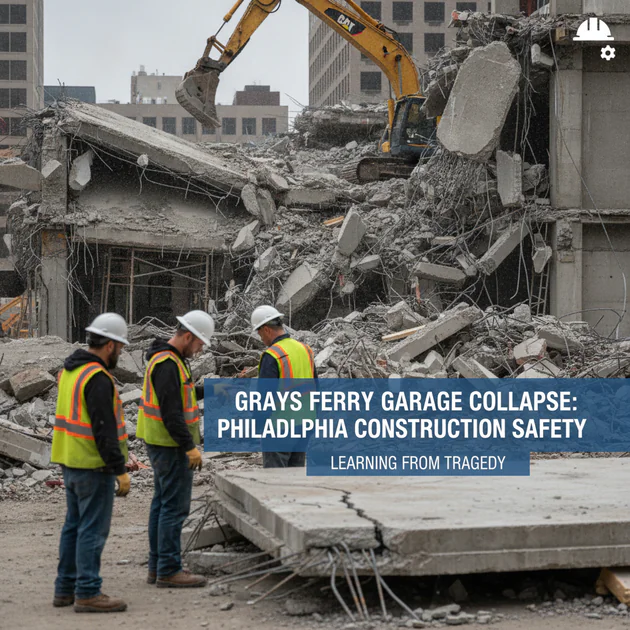

A Grays Ferry Garage Collapse Subcontractor Speaks Out: An In-Depth Analysis
The dust has settled over the site in Grays Ferry, but for the Philadelphia construction community, the aftershocks of the tragic parking garage collapse are still being felt. In the wake of such a catastrophic event, a predictable pattern emerges: official investigations begin, media speculation runs rampant, and legal teams advise a strict code of silence. It is a period of intense scrutiny, where every blueprint, every email, and every daily report becomes a potential piece of evidence in a complex puzzle of liability. For those directly involved—the general contractor, the engineers, and the various trade subcontractors—the pressure is immense.
It is within this charged atmosphere that something highly unusual has occurred. A key player, the concrete subcontractor responsible for the structural slabs, has chosen to come forward. In a detailed statement, they have offered their perspective on the project, their scope of work, and the events leading up to the failure. This is a significant development. Subcontractors are often the first to be scrutinized and the last to be heard in these situations. For a Grays Ferry garage collapse subcontractor to break the silence provides a rare and invaluable opportunity for the entire industry to look beyond the headlines and engage in a critical, lessons-learned analysis.
At Philadelphia Trade Experts, we believe that progress is born from transparency. This article will provide a comprehensive breakdown of the subcontractor’s statement, not to assign blame, but to extract crucial insights. We will delve into the technical specifics of concrete work, explore the complex web of project responsibility, and offer actionable strategies for general contractors, developers, and other trades to enhance safety and mitigate risk on future projects. This is more than just an analysis of a single incident; it’s a vital conversation about the health and integrity of our city’s construction ecosystem.
The Initial Aftermath: Understanding the Silence and the Stakes
To fully appreciate the significance of this subcontractor’s statement, one must first understand the typical post-incident landscape. When a structure fails, the immediate response is a lockdown of information. The Occupational Safety and Health Administration (OSHA) launches an in-depth investigation that can take months. Forensic engineers are hired by insurance companies and legal teams to meticulously pick through the debris, searching for the point of failure. Every party involved on the project, from the architect to the rebar installer, is immediately advised by counsel to cease all public comment.
This silence is not an admission of guilt; it is a standard and necessary legal precaution. The liability on a major construction project is a tangled web. A structural collapse can trigger a cascade of legal actions involving:
- The Property Owner/Developer: Who financed the project and holds ultimate ownership.
- The Architect and Engineers of Record: Responsible for the design, plans, and structural calculations.
- The General Contractor (GC): Responsible for the overall management, scheduling, and safety of the site.
- Multiple Subcontractors: Each responsible for their specific scope of work, such as excavation, steel erection, concrete, plumbing, and electrical.
In this environment, any public statement can be misconstrued and used in future litigation. Subcontractors, in particular, are in a vulnerable position. They often operate on tighter margins and may lack the extensive legal resources of a large GC or developer. Their primary goal is to protect their company, their employees, and their reputation. Speaking out prematurely can jeopardize insurance claims, violate contractual non-disclosure agreements, and paint a target on their back, regardless of their actual culpability. The decision by the Grays Ferry garage collapse subcontractor to issue a public statement is a calculated risk, likely driven by a strong conviction in the quality of their work and a desire to control a narrative that could otherwise be defined by their silence.
Deconstructing the Statement: A Technical Breakdown of the Concrete Scope
The statement from the concrete subcontractor, whom we will refer to as “Keystone Concrete” for this analysis, is not a simple denial of fault. It is a detailed, technical document that methodically outlines their processes and adherence to project specifications. This level of detail is a clear attempt to shift the conversation from a general question of “who is to blame?” to a more specific examination of “where did the system fail?” Let’s break down the key points they raised.
1. Adherence to Specified Concrete Mix Design and Material Integrity
Keystone Concrete’s statement begins by addressing the material itself. They assert that all concrete poured on the project strictly adhered to the mix design specified by the structural engineer of record. This is a critical first point of defense. They claim to have comprehensive documentation to support this, including:
- Batch Tickets: From the concrete supplier for every single truck that arrived on site, detailing the precise mix of cement, aggregate, water, and admixtures.
- Slump Test Records: Performed on-site for each pour to ensure the concrete had the correct workability and water-cement ratio before being placed.
- Cylinder Test Reports: Lab results from third-party testing agencies for concrete cylinders taken from each pour, verifying that the concrete met or exceeded the required compressive strength (typically measured at 7, 14, and 28 days).
By presenting this data, Keystone is effectively arguing that the raw material they worked with was not defective and met all engineering requirements. This preemptively counters any speculation that a “bad batch” of concrete was the cause of the collapse.
2. Documented Placement and Curing Procedures
The second pillar of their argument focuses on workmanship. Pouring concrete is more than just filling forms. Keystone details their adherence to American Concrete Institute (ACI) standards for placement, consolidation, and finishing. More importantly, they address the curing process—the critical period during which concrete gains its strength. They state their daily reports show that all curing protocols, such as applying curing compounds or wet curing, were followed as specified.
However, their statement subtly introduces a crucial variable: the actions of other trades. They note that the project schedule was “aggressive” and raise questions about whether the newly poured slabs were protected from premature loading. Was heavy equipment from other trades moved onto the concrete before it had reached sufficient strength? Was the shoring and reshoring, which supports the slabs as they cure, removed prematurely by the general contractor to expedite the work on the floors below? These are not accusations, but carefully worded questions that highlight the GC’s responsibility for site-wide coordination and protecting the work of all trades.
3. Clarification of Scope: Rebar and Post-Tensioning Systems
Perhaps the most technically significant part of the statement is the clarification of their scope of work. Many modern concrete structures, especially parking garages, use post-tensioning (PT) systems to create strong, slender slabs capable of spanning long distances. This involves laying a grid of steel cables (tendons) within the formwork before the concrete is poured. After the concrete reaches a specific initial strength, these tendons are hydraulically stressed (pulled) and anchored, putting the slab into a state of compression.
Keystone Concrete makes it clear that their contract was for the placement of concrete only. The installation of the reinforcing steel (rebar) and the complex post-tensioning system was, as is common, the responsibility of a separate, specialized subcontractor. Keystone asserts they simply poured the concrete around the steel that was already in place and signed off on by the GC’s superintendent and the special inspector. This is a crucial distinction. A failure could be caused by:
- Improperly placed rebar.
- Incorrect tendon profiles (the “drape” of the cable inside the slab).
- Flawed post-tensioning anchorages.
- Improper stressing of the tendons.
By delineating their scope, the Grays Ferry garage collapse subcontractor is pointing investigators toward the complex interface between trades and the critical importance of the structural steel systems within the concrete itself. They are not blaming the rebar installer, but rather stating a contractual fact: that part of the structural system was outside their control and responsibility.
The Web of Liability: Moving from Blame to Process Improvement
The subcontractor’s statement is a masterclass in professional self-preservation, but it also serves a greater purpose for the industry. It forces us to look at a construction project not as a collection of individual tasks, but as a deeply interconnected system where the success of one trade depends on the performance of many others. The GC sits at the center of this web, responsible for orchestrating the entire process.
A structural failure is rarely the result of a single error. It is more often a chain reaction of smaller, seemingly minor deviations that compound to create a catastrophe. This could include a design ambiguity that wasn’t clarified with a Request for Information (RFI), a substitution of materials that wasn’t properly vetted, or pressure to meet a deadline that led to a shortcut in safety protocols. The statement from the concrete subcontractor highlights several potential weak points in the project management chain:
- Inter-Trade Coordination: Was there a clear and enforced plan for the sequence of work? Did the team responsible for removing shoring have direct communication with the team that verified the concrete’s strength?
- Special Inspections and Quality Control: While the subcontractor had their own QC, the GC is responsible for overseeing the third-party special inspectors who verify critical elements like rebar placement and concrete strength. Were these inspections performed diligently and were their reports given the weight they deserved?
- Management of Schedule Pressure: An aggressive schedule is a reality on most projects. However, the GC must be the ultimate authority who can push back against owner demands when the schedule threatens to compromise safety or material integrity. The decision to allow other trades to work on or below a freshly poured slab is a critical one that rests squarely with the GC’s site leadership.
This incident, and the subcontractor’s perspective on it, should serve as a wake-up call. The goal of the investigation should not be to find a single scapegoat. The goal must be to identify every broken link in the project delivery chain and to develop more robust systems to prevent a similar tragedy from ever happening again.
Actionable Lessons for Philadelphia’s Construction Leaders
The testimony from the Grays Ferry garage collapse subcontractor provides a powerful foundation for reflection and action. For general contractors, developers, and project managers in the Philadelphia region, this is a moment to re-evaluate internal processes. Here are five actionable strategies to build safer, more resilient projects:
1. Enhance Subcontractor Vetting and Onboarding
Go beyond the lowest bid. Your vetting process should include a deep dive into a subcontractor’s safety program, their documentation and quality control processes, and their financial stability. During onboarding, hold a specific pre-construction meeting with all key trades to review the critical path, identify high-risk interfaces (like the handoff between rebar, concrete, and post-tensioning), and establish crystal-clear communication protocols.
2. Empower On-Site Leadership to Uphold Timelines
Project superintendents are on the front lines. They must be empowered by executive leadership to enforce the project schedule without caving to external pressures that compromise safety. This means if the structural engineer specifies that shoring must remain for 21 days, the superintendent has the authority to hold that line, even if it impacts the flooring contractor’s start date. Their primary metric for success must be safety and quality, not just speed.
3. Invest in Redundant Quality Assurance
Do not rely solely on the subcontractor’s internal QC. While special inspections are often required by code, consider engaging an independent testing and engineering firm to act as the owner’s or GC’s representative. This provides an extra layer of verification for critical structural components, from the foundation rebar to the final concrete strength tests. This small upfront cost can prevent catastrophic downstream failures.
4. Champion a “Speak Up” Safety Culture
Every person on a job site, from the newest laborer to the most experienced foreman, should feel empowered to stop work if they see something unsafe. This requires a top-down commitment from the GC. It means creating formal and anonymous channels for reporting concerns and, most importantly, acting on those concerns without reprisal. A subcontractor who feels they can raise a red flag about a potential issue via an RFI without being labeled as “difficult” is an invaluable asset for risk management.
5. Leverage Technology for Better Documentation
In the aftermath of the collapse, documentation is everything. Modern construction management software allows for real-time tracking of daily reports, photos, RFIs, submittals, and inspection reports. A robust, cloud-based system creates an unchangeable digital record of the project’s history. This not only protects all parties in the event of a dispute but also promotes accountability and transparency throughout the construction process.
Frequently Asked Questions (FAQ)
What is the most common cause of concrete structural failures?
There is rarely a single cause. Most failures result from a combination of factors. Common contributing issues include: design errors or omissions by the structural engineer, use of substandard materials, improper construction methods (like inadequate concrete consolidation or premature removal of shoring), insufficient steel reinforcement, and overloading the structure before it has reached its full design strength. The investigation into the Grays Ferry collapse will likely uncover a sequence of events rather than one single error.
How is liability typically determined in a construction collapse?
Determining liability is a long and complex process. It involves multiple investigations by OSHA, insurance carriers, and forensic engineering firms hired by all involved parties. Investigators will review all project documents: contracts, blueprints, shop drawings, RFIs, daily logs, inspection reports, and material test results. They will also conduct physical tests on materials from the debris. Ultimately, liability is assigned through legal proceedings or settlement negotiations, and it is often shared among multiple parties, including the owner, designer, general contractor, and relevant subcontractors.
As a subcontractor, what is the best way to protect my company on a project?
Meticulous documentation is paramount. Document everything: every conversation, every directive, every delay. Use RFIs to clarify any ambiguity in the plans or specifications. Take daily photos and videos of your work progress and the conditions of the site. Maintain pristine records of your material sourcing and internal quality control tests. Strictly adhere to your contracted scope of work and do not perform extra work without a formal change order. Finally, ensure you have adequate insurance coverage.
Why would a subcontractor like the one in the Grays Ferry garage collapse case speak out?
While legally risky, there are several strategic reasons. First, it allows them to get ahead of the story and frame the narrative based on their evidence, rather than letting others speculate. Second, if they are confident their work was performed correctly, a transparent statement can help preserve their professional reputation within the industry. Third, it can serve as a signal to their employees and other clients that they stand by their work and have robust processes. It is a bold move that suggests a high degree of confidence in their documentation.
Conclusion: Building a Stronger, Safer Philadelphia
The statement from the Grays Ferry garage collapse subcontractor is more than just a legal defense; it’s a critical piece of testimony for the entire Philadelphia construction industry. It pulls back the curtain on the immense complexities of a modern construction project and underscores the fact that safety is a shared responsibility. The strength of a building is not just in its concrete and steel, but in the communication, coordination, and integrity of the teams who build it.
Moving forward, the focus must shift from assigning blame to implementing systemic improvements. This incident must become a catalyst for change, prompting every GC, developer, and subcontractor in the city to ask tough questions about their own processes. Are we prioritizing schedule over safety? Are our communication channels effective? Are we fostering a culture where every team member is empowered to be a guardian of quality?
At Philadelphia Trade Experts, we are committed to helping our clients answer these questions. We believe that by fostering transparency, promoting best practices, and learning from even the most tragic events, we can build a stronger, safer, and more resilient city for everyone. If this incident has you re-evaluating your project management or risk mitigation strategies, we are here to help. Let’s work together to ensure that a tragedy like this never happens again.