
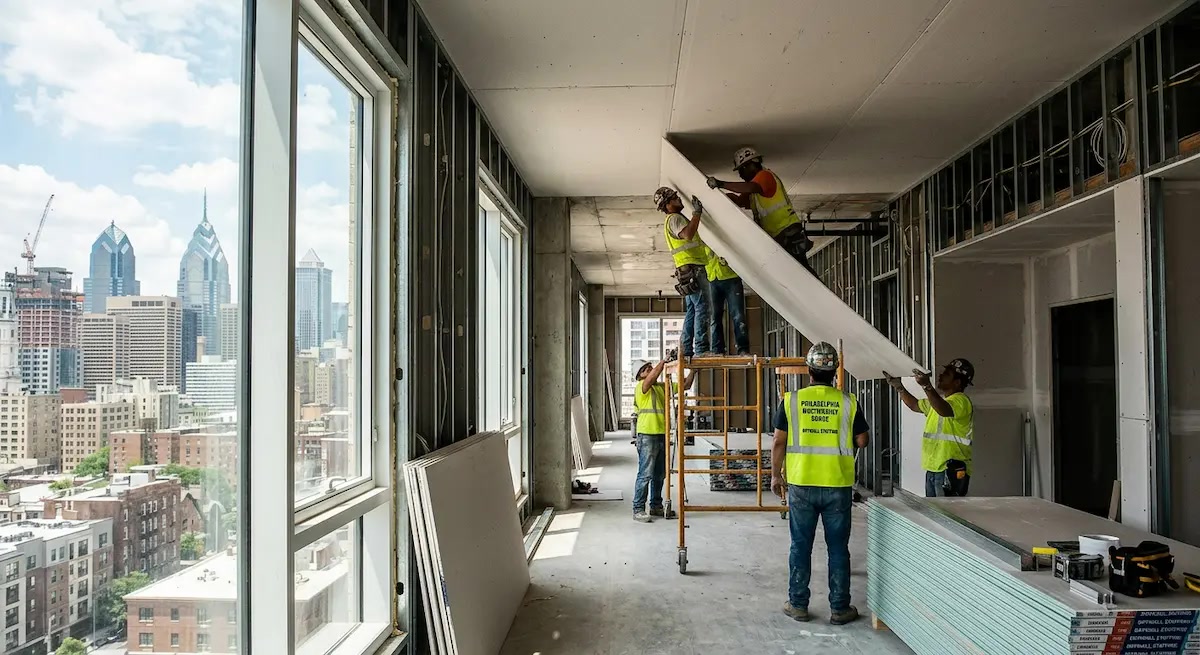
General contractors and drywall specialty firms working downtown Philadelphia already feel the pressure: apartment floors are stacking board, tape, and paint into the same tight calendars that once belonged to office fit-outs. Center City drywall staffing is how those teams keep hangers, tapers, and finishers on the critical path when Central City delivers a disproportionate share of the city’s new homes. Treat crew availability as a preconstruction line item—not a week-of text blast—and you protect turnover dates instead of absorbing idle scaffolds and remobilization costs.
The market signal is local and recent. According to coverage summarizing Center City District analysis via Ground News / Epoch Times, more than 4,000 new homes are slated for Central City between January 2025 and June 2026—about 40% of citywide new-home construction in that window—even though Central City is only a small slice of Philadelphia’s land area. Citywide, more than 10,000 homes are expected to complete in the same period. That concentration means multifamily interiors, not suburban greenfield alone, will drive much of the near-term demand for reliable drywall crews.
Why Center City drywall staffing matters in the multifamily surge
Multifamily towers and large adaptive-reuse apartment projects create a labor profile that rewards flexible, job-ready interiors teams. Unit stacks repeat, but so do punch lists, inspection callbacks, and overlapping MEP rough-ins. A crew that can hang cleanly on one floor while another floor is still in rough-in is more valuable than a single oversized gang that sits waiting on inspections. That is exactly where proactive Center City drywall staffing protects schedule risk for GCs and owners.
WHYY’s reporting on Philadelphia’s Center City apartment boom puts the pipeline in practical terms: roughly 10,000 units completed citywide in the recent wave, with about 5,600 still underway—including a major package of 622 units tied to the Wanamaker project. Those are not abstract “housing starts.” They are corridors, bathrooms, kitchen walls, and common-area feature walls that all need board, joint compound, and a finish level that survives lighting and paint. When several downtown addresses hit interiors at once, the open market for hangers and finishers tightens fast.
Philly Trade Experts works with Philadelphia contractors who need screened drywall professionals—including pathways familiar with PTTI training culture and OSHA jobsite expectations—so you are matching people to unit stacks instead of gambling on walk-up day labor. For service context, see our concrete and drywall staffing overview and planning habits in our permit-delay staffing guide.
Wanamaker-scale apartments and what interiors actually require
Large Center City apartment deliveries rarely need “drywall help” in the abstract. They need named scopes with clear start dates:
- Bulk hanging on repeating unit types and corridor walls
- Taping and finishing to a specified level (often Level 4 in living spaces under critical light)
- Shaft, stair, and mechanical-room board with fire-rated assemblies
- Punch and repair crews after paint or flooring reveals fasteners and ridges
- Short-notice surge finishers when a floor fails inspection before the next trade can start
On Wanamaker-scale loft and apartment work, logistics matter as much as skill. Freight-elevator windows, partially occupied towers, and street-closure staging all punish crews who only know open suburban townhome runs. A staffing brief that lists finish level, access constraints, shift timing, and whether residents or commercial tenants are already in the building will get better matches than a one-line “need drywall ASAP” message. That discipline is the difference between useful downtown drywall crew matching and expensive no-shows.
Level 4 drywall finish and punch-list pressure on Center City drywall staffing
Apartment lighting is unforgiving. Grazing LED fixtures and large windows expose every ridge, nail pop, and poorly feathered joint. Specifying Level 4 drywall finish (or higher in feature areas) is common on multifamily interiors in Philadelphia—and it only works if finishers understand sanding discipline, primer timing, and how to sequence repairs after painters mark defects. Hiring managers who staff “anyone who can hang board” often pay twice: once for the first pass, again for callbacks that delay unit turnover.
Build your request around the finish level, not just headcount. Three Level 4 finishers for two weeks of punch is a different product than ten hangers for bulk board. Clear Center City drywall staffing briefs also note whether you need fire-tape competence, acoustical assemblies between units, or experience with metal stud systems typical of high-rise apartments.
Secondary signals: warehouse bids and local drywall hiring color
Residential towers are not the only drywall demand signal in the metro. A recent PlanHub listing for a commercial/industrial warehouse and distribution project in Philadelphia includes drywall among the trades in the bid package. That secondary commercial pipeline matters because the same pool of hangers and finishers often floats between multifamily interiors and light-commercial fit-outs. When warehouse and apartment schedules overlap, last-minute hiring gets expensive.
Local hiring posts add color without turning this into a job board: specialty firms have looked for drywall finishers (including PatchitUP-style finishing shops), electrical contractors sometimes advertise drywall/paint scopes adjacent to their core trade (Mister Sparky–type postings), and large GCs such as Turner periodically seek project managers comfortable with self-perform drywall environments. Read those ads as evidence that drywall labor demand is real across residential and commercial—not as a list of places to spam resumes. For GCs, the takeaway is simple: plan downtown drywall crew coverage during preconstruction, while unit counts and elevator schedules are still negotiable.
How GCs should brief a Center City drywall staffing partner
Hiring managers who get consistent results treat staffing like a submittal package. Share:
- Scope and finish level — hang only vs. tape/finish; Level 4 vs. Level 5 feature walls
- Headcount and duration — four hangers for three weeks differs from two finishers for punch week
- Site constraints — Center City freight elevators, night work, occupied floors, street closures
- Compliance expectations — OSHA orientation, badging, drug screen, site-specific safety
- Decision timeline — when you need names versus when board is delivered to the floor
That brief lets a partner match drywall professionals who already understand Philly commercial and multifamily paces. It also reduces the risk of no-shows that wreck a hanging sequence and cascade into paint delays. If your pipeline includes both concrete and interiors on the same address, say so early; conversion and new multifamily floors often need sequenced support, and you do not want two separate last-minute hunts.
For contractors balancing multiple downtown addresses, a recurring relationship usually beats one-off panic calls. Once a partner knows your superintendents, preferred shift patterns, and quality bar, each new request for Center City drywall staffing moves faster—and schedule risk drops.
Apartment construction drywall crews: plan the difference from office fit-out
Traditional Center City office fit-outs reward small, precise crews and tenant-driven change orders. Multifamily unit stacks reward rhythm: repeating bathrooms, repeating kitchen walls, corridor progress that must stay ahead of flooring and paint. The staffing model has to flex with the floor cycle. One week you need hangers to clear a stack; the next week you need finishers who can close punch while painters are already on adjacent floors.
Experienced GCs increasingly separate the core drywall subcontract from surge support. Keep your specialty contractor accountable for quality and assemblies, then use Center City drywall staffing to fill verified gaps—night shifts, inspection rework, overlapping towers—without diluting ownership of the finish. Document who owns punch quality on each ticket so temporary labor never becomes an excuse for unit turnover delays.
Also budget for urban logistics: curb space, board delivery, and elevator reservations can erase an hour of productive hanging if the crew arrives without a site-specific plan. Share those constraints in the staffing request so candidates who have worked constrained Philly towers can self-select in—and candidates who only know open suburban slabs and townhomes can self-select out.
Soft next step for GCs and hiring managers
Philly Trade Experts helps Philadelphia construction companies staff drywall (and concrete) roles with screened, job-ready professionals—aligned with the PTTI training culture and OSHA-minded jobsite habits contractors expect on serious multifamily work. If a Center City apartment phase is approaching—Wanamaker-scale interiors, another downtown tower hitting board, or a corridor package that cannot slip—tell us the hanging dates, finish level, headcount, and site constraints. We will help you build a practical crew plan instead of gambling on the open market.
Ready to talk through an upcoming interiors package? Contact Philly Trade Experts or book a consultation and share your staffing window. We will respond with clear next steps so your multifamily drywall sequence stays on the critical path.
Sources: Ground News / Epoch Times — Housing Construction Heats up in Downtown Philadelphia (CCD analysis); WHYY — Center City apartment construction boom; PlanHub — Philadelphia warehouse/distribution bid (drywall listed).
Leave a Reply