
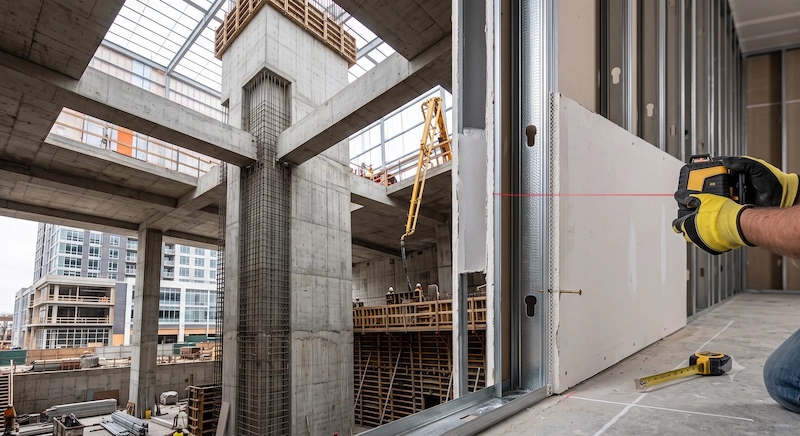
Arena construction staffing is the part of the South Philadelphia venue that gets decided years before the first truck arrives. The $1.5 billion project is moving: Turner Construction and AECOM Hunt lead the PACT+ joint venture, Populous and Moody Nolan have released renderings, and the team is targeting a 2027 groundbreaking with a 2030 opening.
For concrete and drywall contractors, the work is no longer hypothetical. The question is who will be available when the packages land, and who will still be available in 2029 when interiors peak and three other Philadelphia projects are chasing the same finishers.
Quick answer: the new arena is a roughly $1.5 billion, fully privately funded venue on the former Spectrum grounds in the South Philadelphia Sports Complex. Concrete starts after an early-2027 groundbreaking. Drywall peaks in 2028–2029. Arena construction staffing belongs in preconstruction, not in a week-of phone call.
What the South Philadelphia arena project includes
The project has moved past the proposal stage. The construction manager is named, the design team is under contract, and the approvals calendar now drives everything else. Here is the short version a subcontractor needs before a prequalification conversation.
- Location: South Philadelphia Sports Complex, on the former Spectrum grounds—a site with history, active neighbors, and very little staging room.
- Construction manager: PACT+, a joint venture led by Turner Construction and AECOM Hunt, with Philadelphia firms Perryman Construction, Hunter Roberts Construction Group, and Camfred Construction. Turner announced the award in October 2025.
- Design team: Populous, the sports venue specialist, working with Moody Nolan.
- Value: approximately $1.5 billion in construction value, as reported by Construction Dive.
- Schedule: groundbreaking targeted for early 2027 pending city approvals, with a 2030 opening timed to the debut of Philadelphia’s WNBA team.
- Economic claim: project officials project nearly 15,000 jobs and close to $6 billion in economic activity over ten years, according to NBC10 Philadelphia.
- Funding: fully privately financed—described by the project team as the largest fully privately funded project in Philadelphia history.
That combination matters for trades. A privately funded venue with a hard public opening date behaves differently from a speculative office tower. There is no tenant waiting to negotiate a delay. The opening is a product launch, a season schedule, and a revenue date at once.
Why arena construction staffing differs from multifamily work
Arena construction is not a scaled-up apartment building. It is a different labor profile, and staffing it with multifamily habits is how contractors get into trouble.
A labor profile that repeats almost nothing
An apartment tower repeats one unit type forty times. An arena repeats almost nothing. The bowl is a single high-reach volume with a curved ceiling plane. The back of house is a dense warren of locker rooms, broadcast rooms, kitchens, and mechanical spaces, each with its own fire rating, moisture exposure, and finish expectation.
That mix means the drywall package alone can absorb several distinct crews: high-reach hangers in the bowl, production hangers in the back of house, fire-taping specialists, Level 5 finishers in premium areas, and a punch crew working after the seats and scoreboard are installed.
The regional pipeline is already tight
Add the rest of the market and the math gets tighter. The arena will overlap with Center City multifamily interiors and office conversions already competing for the same finishers. We covered that pressure in our breakdown of Center City drywall staffing for the multifamily surge and our look at concrete staffing for Center City office conversions. Arena construction staffing does not create a new labor pool. It competes for the one that already exists.
Concrete scope: where arena construction staffing starts
Concrete sets the pace for every trade behind it. On a venue of this size, the foundation and structural packages are also the first real test of whether a contractor can hold a crew through a Philadelphia winter.
Site work on a live sports campus
The Spectrum site is not a greenfield. It sits inside an operating sports and entertainment district with event-day traffic, parking operations, and utility infrastructure that cannot be interrupted on a game night. Early concrete work will be shaped as much by access windows as by pour size.
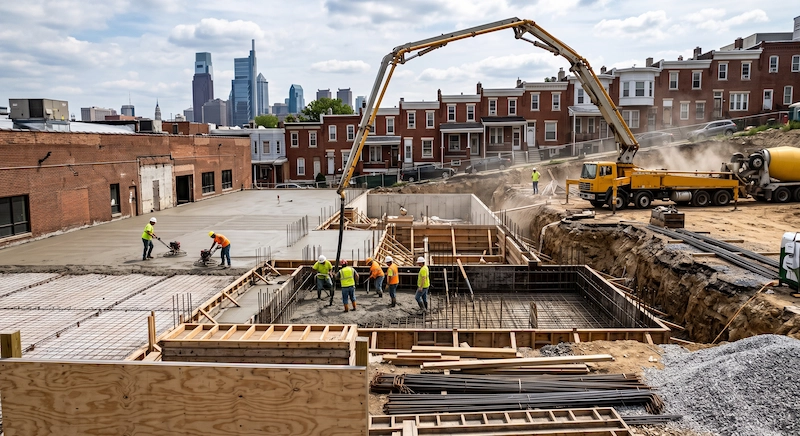
For contractors, that means crews who have worked constrained urban sites, understand how to sequence around delivery windows, and can mobilize without a large laydown area. A foundation crew that has only worked suburban warehouses will cost more in lost hours than in wages.
Structural concrete and the Philadelphia winter
A 2027 groundbreaking in Philadelphia means the first structural pours land in cold weather. Cold-weather concrete is a planning problem before it is a placing problem: heated enclosures, accelerated mixes, temperature monitoring, and cylinder breaks that do not lie. When a pour slips because the enclosure is not ready, the cost is not just the concrete. It is the rebar crew, the pump, the inspection slot, and the crane window behind it.
That is why arena construction staffing on a project this scale should be built around verified cold-weather experience, not headcount alone. Ask for foremen who have run winter decks in the Northeast, not merely workers who have placed concrete. Our guide to permit delays and staffing covers the same principle: the labor plan has to absorb the approval calendar instead of pretending it does not exist.
Drywall: the arena construction staffing peak
Interiors are where the schedule gets decided. Roughly two years of work compresses into a final push, and every finish decision made in preconstruction shows up on a floor schedule.
The bowl, acoustics, and high-reach work
Arena drywall is not primarily a wall problem. It is a ceiling, acoustic, and fire-separation problem at height. The bowl ceiling carries acoustical treatments, access panels, rigging coordination, and lighting integration, all sequenced with steel, MEP, and seating.
High-reach work changes the arena construction staffing model. You need hangers and finishers who are comfortable on lifts and scaffold, who can hold a consistent plane across a curved surface, and who can work cleanly around embedded systems. It also changes the supervision ratio. A bowl crew with weak layout discipline will produce waves that no amount of paint will hide.
Fire-rated back-of-house and Level 5 finishes
The back of house is where schedule risk concentrates. Locker rooms, showers, kitchens, and training areas need moisture-resistant board and substrates that survive daily humidity. Corridors and shafts need fire-rated assemblies with documented penetration detailing. Broadcast and control rooms need acoustic separation that depends on airtight execution, not just the right board.
Premium spaces usually specify Level 5 finish, because grazing light and large windows expose every ridge and fastener. Level 5 is a process discipline: proper substrate, skim coat, controlled sanding, primer timing, and repair sequencing after other trades. This is where arena construction staffing decisions get expensive, because a Level 3 crew in a Level 5 room creates rework that costs more than the original labor.
For a comparison of how interior packages behave under schedule pressure, our post on drywall staffing along the PHL Airport corridor covers the same dynamic in a different asset type: phased access, occupied adjacencies, and finishes that cannot be reworked after turnover.
Arena construction staffing timeline, 2026 to 2030
A realistic arena construction staffing plan follows the package calendar, not the headline schedule. The headline says 2030. The calendar says the hiring decisions happen much earlier.
| Phase | Typical window | Dominant trades | Staffing action |
|---|---|---|---|
| Preconstruction and prequalification | Now through 2026 | Estimating, BIM, safety | Build the labor rate sheet and crew commitments before packages bid |
| Site work and foundations | 2027 | Excavation, formwork, rebar, concrete | Lock foremen and pump crews; plan cold-weather coverage |
| Structure and enclosure | 2027–2028 | Structural concrete, steel, exterior | Hold a bench of deck and slab crews across the winter |
| Interiors and bowl finishes | 2028–2029 | Hangers, tapers, finishers, ceiling crews | Ramp in waves; add Level 5 finishers and fire-taping specialists |
| Fit-out, commissioning, punch | 2029–2030 | Punch carpenters, repair finishers, painters | Reserve a dedicated punch crew; do not strip the A-team early |
Two things go wrong on timelines like this. Contractors staff to the award date instead of the peak date, and they release the punch crew before the owner walkthrough. Both decisions look efficient in a spreadsheet and both surface as overtime later.
How subcontractors can win PACT+ packages
Arena construction staffing and subcontractor prequalification run on the same clock. Large venue work is prequalified, not cold-called, and the preparation starts well before the bid invitation.
- Safety record first. Experience modification rate, OSHA 30 supervision, fall protection program, and a clean three-year incident history carry more weight on a venue than a low unit price. Federal OSHA construction standards are the floor, not the differentiator.
- Proof of capacity, not claims of capacity. Show comparable square footage, crew counts by month, and the names of superintendents who will actually be on site.
- Coordination maturity. Arena work is BIM-heavy. Contractors who can model, clash-detect, and sequence in the model are easier to schedule than contractors who cannot.
- Local participation. The PACT+ structure deliberately includes Philadelphia firms. Local hire commitments and a documented city workforce plan are commercial advantages, not just compliance boxes.
- Compliance infrastructure. Certified payroll, apprenticeship ratios, and prevailing-wage documentation should be routine before the first invoice, not a scramble after it.
How to brief an arena construction staffing partner
Most staffing requests fail because they describe a trade instead of a package. “Need drywall guys” gives a supplier nothing to match. A brief that mirrors a submittal gets a usable crew.
- Scope and system: hang only, tape and finish, or full assembly—plus board type, fire rating, and acoustic requirement.
- Finish level: Level 4 versus Level 5, and which rooms carry the higher spec.
- Headcount by phase: six hangers for eight weeks is a different request than two finishers for punch week.
- Access and logistics: hoist and elevator windows, material staging, gate times, event-day restrictions.
- Shift pattern: day, swing, or night—and whether the site allows consecutive shifts.
- Compliance: orientation, badging, drug screen, background check, and site-specific safety training.
- Ramp and release dates: when the crew must be productive, and when you intend to release them.
That level of detail separates a staffing partner from a labor broker. It also protects the contractor: when the brief is clear, a no-show is a supplier failure instead of a mutual misunderstanding.
Risks that blow arena construction staffing schedules
Most arena construction staffing failures are scheduling failures in disguise. The crew was fine. The plan around them was not.
- The award-to-mobilization gap. Packages are often awarded months before the floor is ready. Crews booked at award drift to other jobs by mobilization.
- Finish-level mismatch. Sending production hangers into a Level 5 premium area creates rework that costs more than the original labor.
- Hoist and elevator time. Board and compound movement is the real constraint in a vertical venue, not hanging speed.
- Inspection sequencing. Fire-rated assemblies and shaft walls must be inspected before closure. One missed inspection holds an entire floor.
- Punch labor released too early. The last five percent of an arena takes a disproportionate share of hours. Plan for it.
- Overtime spiral. When a schedule slips, the instinct is to buy hours. Past a certain point, overtime produces fatigue, defects, and rework instead of progress.
Arena construction staffing FAQ
When does construction start on the South Philadelphia arena?
Planners are targeting a groundbreaking in early 2027, pending city approvals. Preconstruction and package procurement are already underway, which is when arena construction staffing commitments should be made.
Who is building the arena?
PACT+, a joint venture led by Turner Construction and AECOM Hunt, with Philadelphia firms Perryman Construction, Hunter Roberts Construction Group, and Camfred Construction. Populous and Moody Nolan lead the design.
How much will the arena cost?
Construction Dive reports a construction value of approximately $1.5 billion. It is fully privately funded and described as the largest project of its kind in Philadelphia history.
How many construction jobs will the arena create?
Project officials project nearly 15,000 jobs and close to $6 billion in economic activity over ten years. Those figures span construction and ongoing operations, so contractors should plan against their own package schedules rather than the headline number.
What trades will the arena need most?
Concrete place and finish crews, formwork carpenters, rebar, structural steel, drywall hangers, tapers, finishers, acoustical ceiling crews, painters, and MEP trades. Arena construction staffing for the interiors phase will be tightest in 2028 and 2029.
Will Philadelphia contractors get work on the arena?
The construction manager structure explicitly includes three Philadelphia-based firms, and local participation is a stated priority. Local subcontractors should expect prequalification to weigh safety performance, capacity, and documented workforce plans.
Next step for arena construction staffing
Philly Trade Experts supplies screened concrete and drywall professionals to Philadelphia contractors working on complex, schedule-driven projects. We match crews to packages rather than job titles, so foremen arrive with the right finish-level experience, the right certifications, and a realistic understanding of site access before the first shift.
If your pipeline includes arena-adjacent work, a Sports Complex package, or a downtown interior that cannot slip, start the conversation early. Review our concrete and drywall placement services, see how to hire concrete pros for structural packages, or book a consultation and share your package, phase dates, finish levels, and headcount by month. We will come back with a practical crew plan instead of a rate card and a promise.
For contractors who want to move faster, contact Philly Trade Experts directly with your bid date and the packages you are pursuing. Early conversations are how good crews end up on the right floors.
Sources: Turner Construction — PACT+ joint venture announcement; NBC10 Philadelphia — first look at the new arena; Construction Dive — Turner-AECOM Hunt team for $1.5B Philadelphia venue; ESPN — arena for 76ers, Flyers to open in 2030.
Leave a Reply