
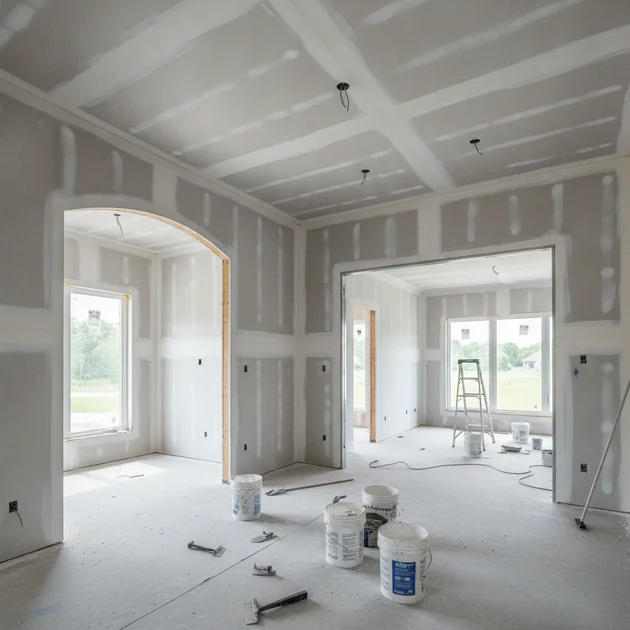
The transformation of a construction project from a skeletal frame of lumber and steel into a collection of defined, livable spaces is a pivotal moment. It’s the stage where architectural drawings begin to feel like a home. At Philadelphia Trade Experts, we’ve just reached this critical milestone at our Kalos Street custom home project. The expert installation of all drywall is complete, and the interior is now a clean canvas, ready for the intricate layers of finishing that will bring the client’s vision to life. This isn’t just about hanging boards; it’s about setting the standard for the quality of every surface that will follow.
This article offers an in-depth look at this essential construction phase, using our work on Kalos Street as a real-world case study. We will explore the nuances that separate a standard job from a luxury finish, delving into material selection, advanced techniques, and the rigorous project management required to execute flawlessly. For fellow construction professionals, developers, and discerning clients in Philadelphia, this deep dive showcases the precision and expertise that underpin a truly high-end build. Understanding the complexities of a professional drywall installation is key to appreciating the foundation of an impeccable interior finish.
In This Article:
- The Foundation of a Flawless Finish: More Than Just Gypsum Board
- Project Management Excellence: Our Approach to Drywall
- Kalos Street Drywall: Challenges and Solutions in a Custom Build
- Achieving Level 5 Finish: The Gold Standard in Residential Drywall Philly
- Beyond the Boards: The Critical Next Steps in Interior Finishing
- Frequently Asked Questions About Professional Drywall Installation
- Join Us on the Kalos Street Journey
The Foundation of a Flawless Finish: More Than Just Gypsum Board
At its core, drywall is a simple yet brilliant invention: a panel made of calcium sulfate dihydrate, or gypsum, pressed between two thick sheets of paper. This gypsum board is the standard for interior walls and ceilings in modern construction, prized for its fire resistance, cost-effectiveness, and versatility. However, to view it as a mere commodity is to overlook its fundamental importance in the quality of the final build. The type of drywall selected and the quality of its installation dictate the look, feel, and longevity of every interior surface.
For a custom project like Kalos Street, a one-size-fits-all approach is unacceptable. Different areas of the home demand different performance characteristics from the gypsum board. Our material selection process is meticulous, ensuring the right product is used in the right application. This strategic approach prevents future issues like moisture damage, improves sound dampening, and enhances overall safety.
- Standard Drywall: Used in most living areas and bedrooms, this is the workhorse of any residential project. We use high-quality, 1/2-inch or 5/8-inch boards for durability and a solid feel.
- Moisture-Resistant Drywall: Often called “green board” or “purple board,” this is essential for all bathrooms, laundry rooms, and any area with high humidity. It features a special paper and core designed to prevent moisture penetration and inhibit mold growth.
- Fire-Resistant (Type X) Drywall: This thicker, denser drywall contains glass fibers that increase its fire-resistance rating. It’s a code requirement for garage walls and ceilings adjoining the main house, and we often specify it around utility rooms for added safety.
- Sound-Dampening Drywall: For areas like home theaters, offices, or bedrooms adjacent to noisy living spaces, we utilize specialized soundproof drywall. This product has a constrained layer damping polymer between two layers of gypsum, significantly reducing sound transmission between rooms.
Choosing the correct materials is the first step. Without this foundational knowledge, even the most skilled installation will be built on a compromised base. This is a non-negotiable aspect of our commitment to quality and a key part of the initial interior finishing planning phase.
Project Management Excellence: Our Approach to Drywall
A perfect drywall finish is impossible without impeccable construction project management. The “hangers and tapers” can’t simply show up when the framing is done. This phase is a critical intersection point for multiple trades, and orchestrating their work is paramount to avoiding costly rework and delays. At Philadelphia Trade Experts, our process begins long before the first board is carried into the house.
We see the drywall phase not as an isolated task, but as an integral part of a larger system. Our project managers ensure a “clear to cover” state is achieved before any gypsum board is installed. This means every wire, pipe, duct, and piece of in-wall blocking has been installed, inspected, and documented. This verification step prevents the nightmare scenario of having to cut into a perfectly finished wall to fix an electrical or plumbing issue.
Our systematic approach ensures efficiency and superior quality:
- Pre-Installation Verification: A comprehensive walkthrough with the framing, electrical, plumbing, and HVAC leads. We use a detailed checklist to confirm all rough-ins are complete and correctly located according to the plans. This is also when we double-check insulation and vapor barrier installation.
- Material Staging and Acclimatization: Drywall is delivered and “stocked” throughout the house, carefully placed to distribute weight and allow for easy access. Critically, we allow the boards to acclimate to the home’s interior temperature and humidity for at least 48 hours to prevent future cracking or warping.
- Hanging the Gypsum Board: Our skilled team of Philadelphia drywall contractors begins installation. We prioritize ceiling installation first, ensuring tight fits. We use screws instead of nails to prevent “nail pops” and employ techniques like staggering seams to create stronger, more stable walls.
- Taping and Finishing: This is where true artistry comes into play. The process involves applying paper or mesh tape to all seams and corners, followed by multiple, progressively wider coats of joint compound (“mud”). Each coat must fully dry before the next is applied.
- Sanding and Skim Coating: After the final coat of mud is dry, meticulous sanding creates a seamless, uniform surface. For high-end finishes like the one on Kalos Street, this is followed by a skim coat over the entire surface to eliminate any imperfections.
- Final Inspection and Quality Control: Before declaring the phase complete, our site supervisor conducts a rigorous inspection using high-powered lights held at an angle to the wall. This “critical lighting” reveals any minor flaws that would be invisible under normal conditions but could appear after painting.
This disciplined process, managed by our experienced team, is how we deliver predictable, high-quality results. Learn more about our comprehensive project management services.
Kalos Street Drywall: Challenges and Solutions in a Custom Build
The Kalos Street drywall installation was far from a standard “box” job. Custom homes, by their nature, present unique challenges that test the skill and problem-solving abilities of the installation crew. Our team’s experience was essential in navigating these complexities to deliver a flawless result.
One of the primary challenges was the home’s intricate architectural design. This included double-height ceilings in the great room, curved walls in the entryway, and numerous soffits and bulkheads designed to conceal mechanical systems and create architectural interest. These features require an exceptional level of precision. Standard 4×8 sheets of drywall don’t bend easily, and creating smooth, perfect curves or crisp, multi-angled corners is a craft. Our solution involved using specialized flexible gypsum board for the curved sections and employing expert cutters who could scribe and snap boards to fit complex angles perfectly, minimizing the need for excessive joint compound.
Another significant challenge was the deep integration of smart home technology. The plans called for dozens of cutouts for in-ceiling speakers, flush-mount lighting fixtures, security sensors, and touchscreen control panels. The margin for error was zero. A mis-cut could mean damaging expensive wiring or compromising the clean, minimalist aesthetic. Our solution was relentless coordination. We worked directly off the electrician’s and low-voltage contractor’s as-built drawings, using laser levels and precise measurements to mark every single cutout before the boards were lifted into place. This collaborative approach ensured every device would fit perfectly into the finished wall.
Finally, maintaining a pristine job site during the messiest phase of construction was a top priority. Drywall dust, particularly from sanding, is incredibly fine and can infiltrate every corner of a house, compromising HVAC systems and the quality of subsequent finishes. We implemented stringent dust control measures, including creating sealed work zones with plastic barriers, using HEPA-filtered air scrubbers to create negative air pressure, and equipping our sanders with vacuum attachments that capture over 95% of the dust at the source. This not only protected the home but also provided a safer, healthier environment for all tradespeople on site.
Achieving Level 5 Finish: The Gold Standard in Residential Drywall Philly
For a luxury custom home, a standard finish simply isn’t enough. On the Kalos Street project, the client and architect specified a Level 5 Gypsum Board Finish, the highest possible quality standard as defined by the authoritative Gypsum Association. Achieving this level of perfection is what separates true craftsmen from average installers and is a hallmark of high-end residential drywall Philly projects.
To understand the significance of a Level 5 finish, it’s helpful to know the different levels:
-
- Level 0-2: Unfinished or used in areas where appearance is not a concern (e.g., plenum spaces, attics).
- Level 3: A step up, suitable for surfaces that will receive heavy texture or be covered by commercial wallcoverings.
– Level 4: The standard for most residential construction. All joints and fasteners are covered with three coats of compound and sanded. It’s acceptable for flat paints, but imperfections can show under certain lighting or with glossy paints.
- Level 5: The pinnacle of finishing. It includes all the steps of a Level 4 finish, plus a thin “skim coat” of joint compound applied over the entire surface of the drywall. This creates a perfectly uniform, monolithic surface.
Why is Level 5 necessary? The difference becomes apparent under specific conditions. When a wall is painted with a semi-gloss or gloss paint, or when it’s subject to “critical lighting” (e.g., strong natural light from a large window raking across a wall), minor textural differences between the paper of the drywall and the joint compound can become visible. This phenomenon, known as “joint flashing” or “photographing,” is completely eliminated by a Level 5 finish. The skim coat ensures the entire wall has the same porosity and texture, so the final paint finish is absolutely flawless from every angle.
The process is labor-intensive, requiring immense skill and patience. After the standard taping and sanding, our finishers apply the skim coat with wide knives or rollers and then meticulously smooth it out. A final, very light sanding prepares the surface for primer. It’s a significant investment in time and labor, but for a project of Kalos Street’s caliber, it’s an essential step to ensure the interior finishing meets the highest standards of luxury.
Beyond the Boards: The Critical Next Steps in Interior Finishing
The completion of the drywall phase is a celebratory milestone, but it also signals the beginning of the highly detailed interior finishing sequence. The smooth, pristine Level 5 surfaces are now the canvas upon which all subsequent design elements will be applied. The quality of our work at this stage directly impacts the success of every trade that follows.
The immediate next step is priming. A high-quality PVA (polyvinyl acetate) drywall primer is applied to every new surface. This is a crucial, non-skippable step. The primer seals the porous surface of the joint compound and new drywall paper, ensuring the topcoats of paint absorb evenly for a consistent sheen and color. Without primer, the paint would soak into the mud and paper at different rates, resulting in a blotchy, unprofessional finish.
Once priming is complete, the project transitions into a carefully orchestrated sequence of events:
- First Coat of Paint: The first coat of ceiling and wall paint is often applied now, before other finishes are installed, allowing for efficient application without extensive cutting-in.
- Flooring Installation: Hardwood, tile, or other flooring materials are installed.
- Cabinetry and Millwork: Kitchen cabinets, bathroom vanities, and built-ins are set in place.
- Trim Carpentry: Baseboards, door and window casings, and crown molding are installed. These elements are installed over the flooring and against the walls, bridging any gaps and adding architectural definition.
- Final Painting: With all the carpentry in place, the final coats of paint are applied to the walls, and all trim is painted, with nail holes filled and seams caulked for a seamless look.
This sequence demonstrates how a small imperfection in the drywall—a slight wave, a poorly sanded seam—can telegraph through and be magnified by each subsequent layer. It underscores our philosophy of integrated project management, where each phase is executed with the next in mind. Adherence to local standards, such as those outlined in Philadelphia’s building permit resources, is also verified at this stage before concealment. Our work provides the perfect foundation, enabling other skilled trades to perform at their best.
Frequently Asked Questions About Professional Drywall Installation
Why can’t I just DIY my drywall installation?
While hanging drywall may seem straightforward, achieving a professional finish is exceptionally difficult for a novice. The real challenge lies in taping and finishing. It takes years of practice to apply joint compound smoothly, feather edges correctly, and sand without creating grooves or imperfections. Professionals have the specialized tools (automatic tapers, banjo boxes, power sanders) and physical conditioning to work efficiently and safely. A DIY job often results in visible seams, uneven surfaces, and an enormous amount of dust, ultimately devaluing the space and requiring professional correction.
What is the difference between drywall and Sheetrock?
This is a common point of confusion. The terms are often used interchangeably, but “Sheetrock” is a specific brand name for gypsum board manufactured by the United States Gypsum Company (USG). It’s a case of a brand name becoming synonymous with a generic product, much like Kleenex for facial tissues or Band-Aid for adhesive bandages. “Drywall” and “gypsum board” are the correct generic terms for the product itself, regardless of the manufacturer.
How long does a typical residential drywall project take?
The timeline for a drywall project varies significantly based on several factors: the square footage of the area, the complexity of the design (e.g., high ceilings, arches), the specified level of finish, and environmental conditions. A key factor is drying time. Each of the three or more coats of joint compound must dry completely before the next can be applied. Rushing this process can lead to cracking and finish failure. For a custom home like Kalos Street, the entire process from hanging to final Level 5 sanding can take several weeks.
How do you handle dust control during the drywall sanding phase?
Professional Philadelphia drywall contractors take dust control extremely seriously. We employ a multi-pronged strategy. First, we isolate the work area using plastic sheeting and zip-up doorways to contain the dust. Second, we use modern sanding equipment connected to HEPA-rated vacuum extractors, which capture the vast majority of dust at the source. Finally, we often use negative air machines (industrial air scrubbers) that vent air to the outside, creating a pressure differential that prevents dust from migrating to other parts of the house. This protects the home’s systems and creates a healthier work environment.
Join Us on the Kalos Street Journey
The completion of the drywall installation at the Kalos Street custom home is a powerful visual marker of progress, transforming the structure into a space with tangible volume and form. But as we’ve explored, this phase is far more than an aesthetic step. It’s a technical discipline that forms the foundational canvas for all future interior finishes. From strategic material selection and meticulous construction project management to the skilled execution of a flawless Level 5 finish, this stage embodies the commitment to excellence that Philadelphia Trade Experts brings to every project.
Our work on Kalos Street serves as a clear example of how experience, precision, and an unwillingness to compromise on quality set the stage for a truly exceptional result. As one of Philadelphia’s premier general contractors, we pride ourselves on mastering every detail, ensuring the finished home is as perfect behind the walls as it is on the surface. The journey at Kalos Street is far from over. From priming and painting to the final fixture installations, the transformation continues. We invite you to follow along with us. Bookmark our project page and watch as this custom house becomes a truly remarkable Philadelphia home.
Leave a Reply