
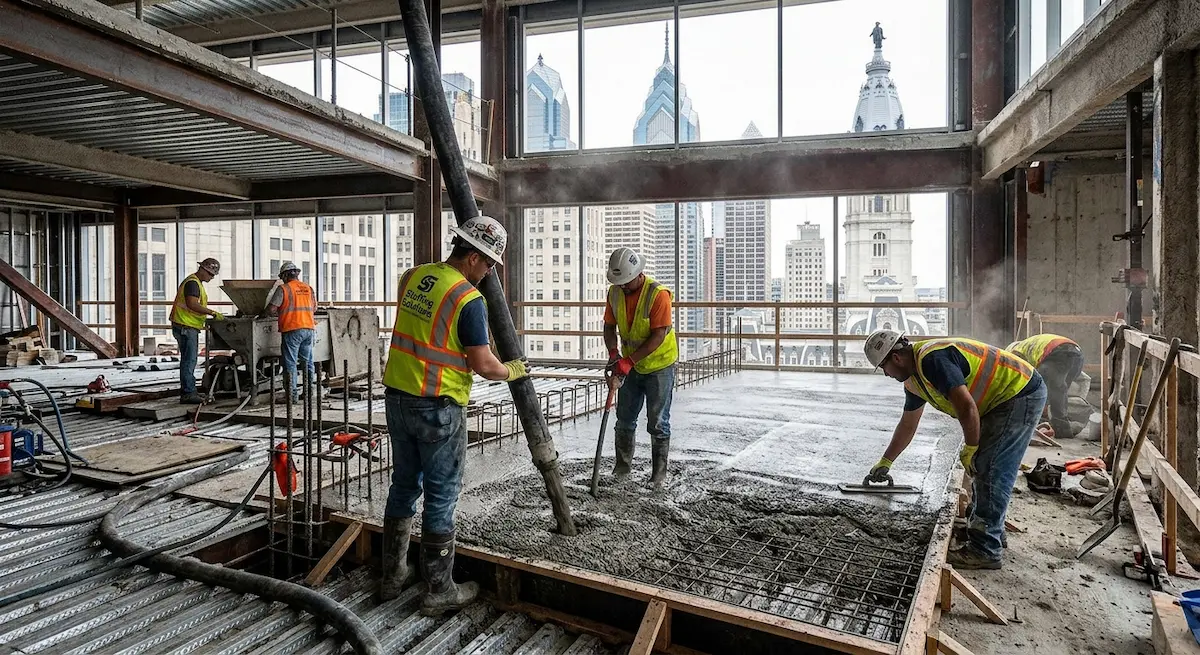
If you are a general contractor or concrete specialty contractor staring down a Center City adaptive-reuse schedule, Philadelphia concrete staffing is no longer a “nice to have” line item—it is the difference between a clean pour window and a stalled floor. Office-to-residential conversions are stacking concrete patching, new elevated slabs, and flatwork into the same tight calendars that already strain drywall and MEP trades. Hiring managers who treat crew availability as a last-minute scramble are the ones paying for idle ready-mix and remobilization.
The market signal is local, not theoretical. According to The Philadelphia Inquirer (April 3, 2026), the metro area began the year with 2,697 apartments in the office-to-residential conversion pipeline—an increase of 119% year over year—and climbed to seventh nationally for conversion activity. Named projects such as the Wanamaker Building redevelopment and Centre Square’s mixed apartment-and-hotel plan mean more occupied-building logistics, more structural repairs, and more demand for crews who can work cleanly on urban jobsites.
Why Center City conversions need Philadelphia concrete staffing now
New multifamily towers and corridor warehouse work still matter in Greater Philly, but conversion jobs create a different labor profile. Floor plates were designed for desks, not residential bathrooms. Elevator cores, slab openings, topping pours, and repair patches show up in waves—not as one continuous greenfield slab. That pattern rewards partners who can scale Philadelphia concrete staffing up and down by phase instead of locking a full crew for months when only a short patch window is live.
Centre Square’s thick poured-concrete construction, called out in local coverage of the redevelopment, is a reminder that adaptive reuse is structurally harder than a typical tenant fit-out. GCs need finishers who understand occupied towers, overnight pours, and coordination with abatement and demolition—not day-laborers learning the building on the first truck.
Meanwhile, traditional multifamily deliveries have softened in parts of the market, which pushes competitive contractors toward conversion and renovation scopes. The winners will be the firms that can still field reliable concrete finishers and laborers when a building owner finally green-lights a phase. That is exactly where proactive Philadelphia concrete staffing protects bid margins.
What scopes GCs actually staff on adaptive-reuse jobs
Conversion schedules rarely need “a concrete company” in the abstract. They need named scopes with clear start dates:
- Selective demolition support and protection of existing slabs
- Formwork help for openings, curbs, and elevated patches
- Cement masons / finishers for toppings, repairs, and architectural flatwork
- Laborers for staging, material handling, and cleanup in constrained Center City access
- Short-notice surge crews when inspection comments force rework before the next trade can start
Philly Trade Experts focuses on connecting contractors with job-ready concrete professionals—including PTTI-trained talent pathways—so you are not inventing a workforce the week the pump shows up. For service context, see our concrete pros hiring page and the broader concrete and drywall staffing overview.
Patch, flatwork, and elevated pours
On Wanamaker-scale loft conversions and similar Center City rehabs, the highest-friction moments are often the small pours: corridor toppings, unit threshold repairs, mechanical-room pads, and elevator-lobby flatwork that must match existing elevations. Those scopes look minor on a Gantt chart and catastrophic when the wrong crew shows up. A staffing brief that lists finish level, access constraints, shift timing, and whether the building is partially occupied will get you better matches than a one-line “need finishers ASAP” text.
Elevated pours inside existing structures also raise safety and logistics requirements. Confirm that candidates understand fall protection, confined staging, and coordination with building engineers. Reliable Philadelphia concrete staffing partners pre-screen for those realities so your superintendent is not running orientation during the pour window.
Wage pressure and why last-minute hiring gets expensive
Wage expectations in Philadelphia’s building trades are not soft. Federal building wage determination PA20260003-14555-bld (effective May 17, 2026) lists a Cement Mason/Concrete Finisher total package of $80.96 per hour (base plus fringe) for covered Philadelphia County building work. Even when your specific job is private and not Davis-Bacon, that published package sets a regional reference point. Contractors who underprice labor or wait until the night before a pour to staff up often pay overtime, premium temp rates, or both.
Local hiring posts reinforce that demand is real: Greater Philadelphia concrete contractors have advertised for journeymen finishers and laborers, and ready-mix producers continue to recruit plant-side roles that keep trucks moving to jobsites. When specialty firms and producers are hiring at the same time conversions need surge crews, the open market tightens fast. Planning Philadelphia concrete staffing during preconstruction—ideally while permits and owner decisions are still moving—beats competing for whoever is left on the morning of the pour. We cover that planning habit in more detail in our permit-delay staffing guide.
How to brief a staffing partner without slowing the pour
Hiring managers who get consistent results treat staffing like a submittal package. Share:
- Scope and finish level — patch vs. structural vs. decorative flatwork
- Headcount and duration — three finishers for two nights is different from ten laborers for six weeks
- Site constraints — Center City street closures, freight elevator windows, night work, occupied floors
- Compliance expectations — OSHA orientation, E-Verify, badging, drug screen
- Decision timeline — when you need names versus when the truck is ordered
That brief lets a staffing partner match concrete finishers and laborers who already understand Philly commercial paces. It also reduces the risk of no-shows that wreck a ready-mix ticket. If your pipeline includes both concrete and interior trades, say so early; conversion floors often need sequenced support, and you do not want two separate last-minute hunts.
For contractors balancing multiple Center City addresses, a recurring relationship is usually cheaper than one-off panic calls. Once a partner knows your superintendents, preferred shift patterns, and quality bar, each new request for Philadelphia concrete staffing moves faster—and your schedule risk drops.
Conversion labor vs. greenfield slabs: plan the difference
Greenfield multifamily pours reward large, stable crews and repetitive floor cycles. Center City conversions punish that assumption. One week you need two finishers for a mechanical pad; the next week you need a larger laborer team to stage materials through a freight elevator that only runs after 6 p.m. The staffing model has to flex with the building, not with a spreadsheet that assumes identical floors.
That is why experienced GCs increasingly separate “base concrete subcontract” from surge support. Keep your core specialty contractor for structural quality and QA, then use Philadelphia concrete staffing to fill verified gaps—night shifts, inspection rework, or overlapping addresses—without diluting accountability. Document who owns finishing quality on each ticket so temporary labor never becomes an excuse for callbacks.
Also budget for urban logistics: curb space, pump placement, and overnight noise rules can erase an hour of productive finishing if the crew arrives without a site-specific plan. Share those constraints in the staffing request so candidates who have worked constrained Philly towers can self-select in—and candidates who only know open suburban slabs can self-select out.
Soft next step for GCs and hiring managers
Philly Trade Experts helps Philadelphia construction companies staff concrete (and drywall) roles with screened, job-ready professionals. If a conversion phase is approaching—Wanamaker-scale loft work, Centre Square–style mixed-use rehab, or a smaller office floor flipping to residential units—tell us the pour dates, headcount, and site constraints. We will help you build a practical crew plan instead of gambling on the open market.
Ready to talk through an upcoming pour or patch package? Contact Philly Trade Experts or book a consultation and share your staffing window. We will respond with clear next steps so your Center City conversion stays on the critical path.
Sources: Inquirer — office conversions April 3, 2026; Prevailing wage WD PA20260003-14555-bld.
Leave a Reply