
Philadelphia VA drywall subcontract work is open for bid right now, and the window is short. The Department of Veterans Affairs Network Contract Office 4 posted a gypsum board and interior painting scope on October 23, 2026, with responses due November 20. It is an SDVOSB set-aside under NAICS 238310, and it sits inside a medical center that has been under continuous renovation for years.
For drywall contractors, this is not a generic commercial fit-out with a federal cover sheet. Hospital interiors carry infection-control barriers, night shifts, badging, and inspection sequences that change how many finishers you can actually put on a floor. Getting the Philadelphia VA drywall subcontract priced correctly starts with understanding that difference.
Quick answer: the scope covers hanging and finishing gypsum board plus interior painting at VA Medical Center projects in Philadelphia, under specification sections 09 29 00 and 09 91 00. It is a Service-Disabled Veteran-Owned Small Business set-aside, NAICS 238310, with a $19 million size standard, posted October 23 and due November 20, 2026. Bidders need SBA veteran certification, hospital experience, and a crew plan that survives ICRA restrictions.
What the Philadelphia VA drywall subcontract covers
The listing is compact, which is normal for a carved-out scope. The details that matter are in the solicitation number, the set-aside, and the specification sections.
- Scope: installation of gypsum board and interior painting at VA Medical Center projects in Philadelphia, including hanging, finishing, and applying interior paint and coatings to deliver completed interior walls.
- Specifications: Section 09 29 00 (Gypsum Board) and Section 09 91 00 (Painting).
- Set-aside: Service-Disabled Veteran-Owned Small Business Concern (SDVOSBC).
- NAICS: 238310, Drywall and Insulation Contractors, with a $19.0 million size standard.
- Posted: October 23, 2026. Responses due: November 20, 2026, 9:00 PM UTC (4:00 PM Eastern).
- Place of performance: Philadelphia, PA 19104.
- Origin: carved out of solicitation 36C24426R0088, tied to the prime scope Z1DA–642-22-104, Upgrade Substation Building 2 Phase 1 at the Philadelphia VAMC.
The full listing and response instructions sit behind the prime solicitation package, which means the drawings, phasing notes, and wage determinations are not all visible from the summary alone. Pull the prime documents before you price a dollar.
Why the VA keeps building in Philadelphia
This scope is not a one-off. In August 2025 the VA announced it would realign an additional $800 million into its Non-Recurring Maintenance program, and the Philadelphia VA Medical Center was named among the recipients.
The published project list reads like a multi-year interiors pipeline: roof replacement across three phases, domestic water line replacement, electrical substation expansion, a new nurse station and nurse call system for inpatient behavioral health, sub-basement renovation, laboratory automation room renovation, interventional radiology, a new linear accelerator, a prosthetics lab, sterile processing upgrades, and EHRM infrastructure upgrades across the main hospital and community clinics.
Almost every one of those projects ends with walls. Corridors get reopened, departments get reconfigured, and equipment replacements require new partitions, ceilings, and finishes. That is why the Philadelphia VA drywall subcontract exists as a standing scope rather than a single job, and why contractors who learn the campus now will keep getting called.
The release pattern matters for labor planning. A Philadelphia VA drywall subcontract rarely arrives as one clean mobilization; it arrives as a series of departmental windows that overlap with equipment installations and inspection schedules.
Who can bid: SDVOSB eligibility in plain terms
The set-aside narrows the field before anyone opens a drawing set. Three tests decide whether you can compete.
- Service-disabled veteran ownership and control. The firm must be at least 51% owned and controlled by one or more service-disabled veterans.
- SBA certification. The VA no longer runs its own verification for most purposes; firms certify through the SBA’s veteran small business certification program. If your certification is pending, start now, not the week the bid is due.
- Size. You must be small under NAICS 238310, which carries a $19.0 million size standard. Revenue and affiliate rules apply.
If you are not eligible, the practical route is to team. Prime contractors working the VA campus need SDVOSB subcontractors to meet their own goals, and a drywall sub with hospital experience is a useful partner regardless of which side of the set-aside you sit on. The SBA veteran contracting programs page is the starting point for eligibility questions.
What hospital drywall work demands
This is where most Philadelphia VA drywall subcontract bids go wrong. Contractors price the square footage like a commercial office and then discover the productivity loss.
Infection control changes the daily plan
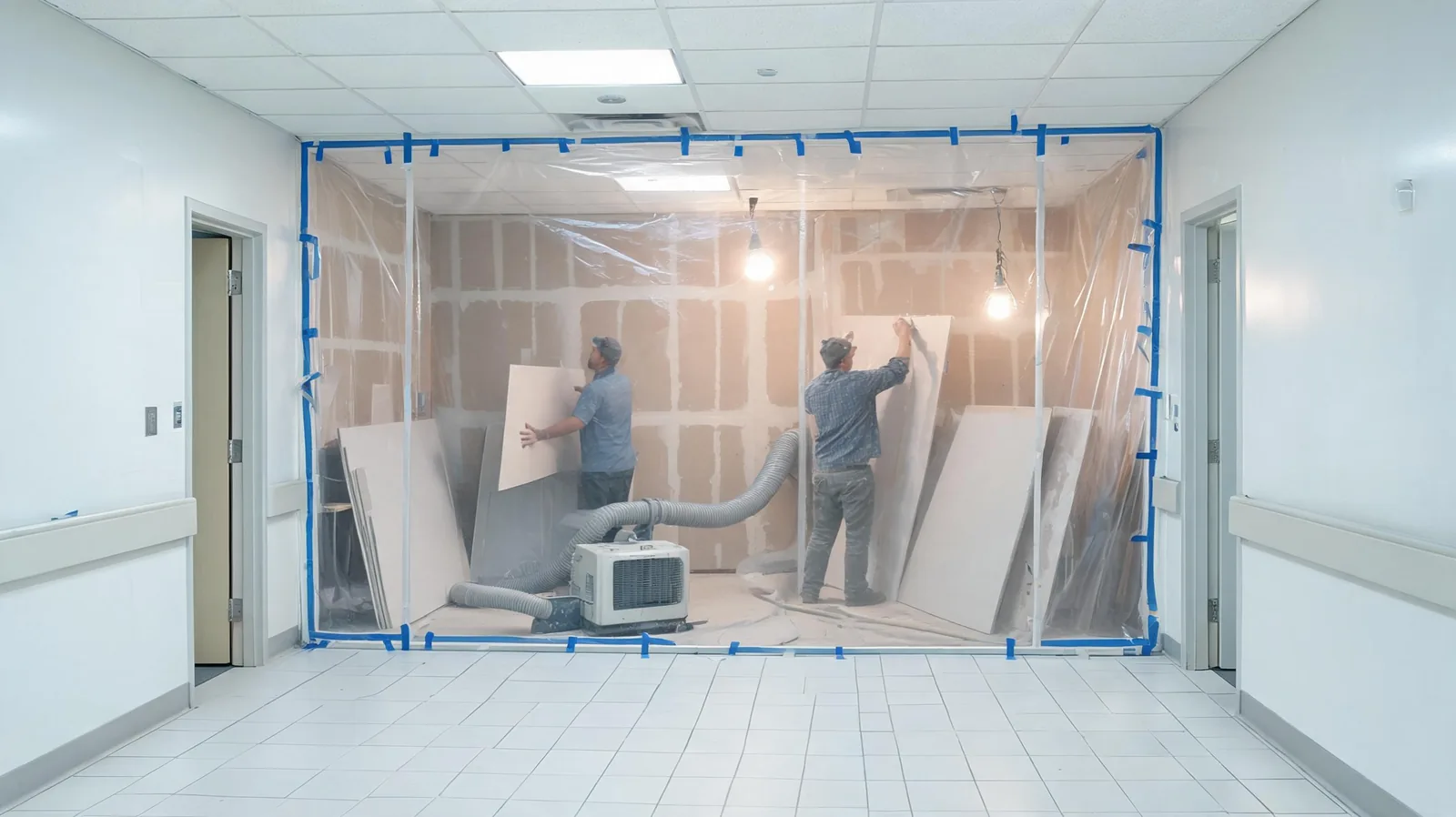
Work in an operating hospital is governed by an infection control risk assessment. In practice that means temporary partitions and negative air machines, sealed returns, daily cleaning, and inspections before anyone cuts board. A corridor may only be available for a four-hour window, and the barrier has to be rebuilt and broken down around patient traffic.
The labor effect is not subtle. A crew that hangs 1,200 square feet in an open commercial shell may hang 400 in a hospital corridor on the same shift, because the barrier, the negative air, and the escort requirements eat the rest.
Badging, screening, and site rules
VA medical centers require badging and background screening, and contractors typically need site-specific safety orientation before mobilization. Some areas require health screening. None of this is negotiable, and all of it takes calendar time, which is why a realistic Philadelphia VA drywall subcontract plan starts with badging, not with board delivery.
Occupied floors and after-hours sequencing
Noise, dust, and vibration restrictions push taping and sanding into nights and weekends in patient areas. That changes supervision. A night shift needs a foreman who can make decisions without the project manager on site, and it needs a punch list that is closed before the shift ends, not carried into the next morning. That night-shift discipline is the part of a Philadelphia VA drywall subcontract that surprises commercial superintendents most.
Staffing the Philadelphia VA drywall subcontract
A Philadelphia VA drywall subcontract is usually a rolling scope, not a single mobilization. Departments release in phases, and each phase runs through the same cycle: barrier, framing, board, tape, finish, paint, inspection, punch.
| Role | Typical mix | Where the hours go |
|---|---|---|
| Hangers | 2–4 per active area | Board, shaft walls, rated assemblies |
| Tapers and finishers | 2–3 per hanger crew | Taping, Level 4/5 finish, sanding |
| Painters | 1–2 per phase | Coatings per 09 91 00, touch-up |
| Ceiling crew | 1–2 | Grid and tile, access coordination |
| Punch and repair | 1–2 | Post-inspection corrections |
| Supervision | 1 per shift | ICRA compliance, inspections, escort coordination |
Two staffing rules follow from hospital conditions. First, keep the crew small and stable rather than large and rotating, because every new worker needs badging and orientation. Second, staff the punch function from the start. In occupied healthcare work, the inspection list is longer and the rework window is shorter than on a commercial job.
Pricing the Philadelphia VA drywall subcontract without losing the job
Federal interior work rewards contractors who price the constraints instead of discovering them. Build the estimate around these realities:
- Productivity factor. Apply a hospital factor to hanging and finishing labor, not a commercial one. Barrier setup and teardown are real hours.
- Shift differentials. Night and weekend work costs more, and it needs its own supervision line.
- Mobilization and demobilization. Phased scopes mobilize more than once. Price each phase.
- Certified payroll and prevailing wage. Federal work requires documentation that a residential crew has never produced.
- Small-quantity inefficiency. A 40-linear-foot corridor patch takes proportionally longer than a full floor.
If your number comes in far below the field, the difference is usually one of those five lines, and it will show up as a loss rather than a win. A Philadelphia VA drywall subcontract that looks cheap at bid time is usually missing the hospital factor somewhere.
Building the bid package
Federal subcontractors get eliminated on paperwork before anyone compares price. Assemble these before you write the technical approach.
- Active SBA veteran certification and a current SAM.gov registration with the right NAICS codes.
- Past performance on occupied healthcare or similarly constrained work, with references who will answer the phone.
- Safety record: EMR, OSHA 30 supervision, and an approach to infection control that a hospital safety officer will accept.
- Labor plan: named foremen, crew counts by phase, and a realistic ramp that accounts for badging lead time.
- Schedule logic: how you will sequence around departmental releases and inspection windows.
- Certified payroll capability and the back-office discipline to file it on time.
For contractors new to this market, our guide to permit delays and staffing covers the same principle on the private side: the labor plan has to absorb the approval calendar instead of pretending it does not exist.
Risks that sink VA interior subcontracts
Most Philadelphia VA drywall subcontract losses are not drywall failures. They are planning failures that surface as labor variance.
- Underestimating ICRA time. Barrier work is unbillable if it was never in the estimate.
- Badging delays. A crew that cannot badge cannot work, and the schedule does not move.
- Inspection sequencing. Rated assemblies must be inspected before closure. One missed inspection idles a floor.
- Scope creep at the edges. Patch-and-repair requests in occupied areas arrive informally and expand fast.
- Punch released too early. The last five percent of a hospital phase takes a disproportionate share of hours.
- Overtime spiral. Buying hours past a certain point produces fatigue, defects, and rework instead of progress.
Philadelphia VA drywall subcontract FAQ
What is the response deadline?
November 20, 2026 at 9:00 PM UTC, which is 4:00 PM Eastern. The scope was posted October 23, 2026, so the window is roughly four weeks.
What NAICS code and size standard apply?
NAICS 238310, Drywall and Insulation Contractors, with a $19.0 million size standard. Size is determined under SBA rules, including affiliate considerations.
Is this a prime contract or a subcontract?
The Philadelphia VA drywall subcontract is a subcontract scope carved out of solicitation 36C24426R0088 and tied to the prime project Z1DA–642-22-104, Upgrade Substation Building 2 Phase 1 at the Philadelphia VAMC.
What specifications govern the work?
Section 09 29 00 for gypsum board and Section 09 91 00 for painting. The full package sits with the prime solicitation, so request those documents before pricing.
Can a non-SDVOSB contractor participate?
Not as the prime on a set-aside scope. Non-eligible firms can participate as subcontractors or suppliers to an eligible firm, or pursue the work through a teaming arrangement.
What experience matters most?
Occupied healthcare work. Hospital infection-control procedures, night-shift supervision, badging compliance, and federal certified payroll experience matter more than raw square footage on open commercial shells. For a Philadelphia VA drywall subcontract, that hospital record is the differentiator.
Next step on the Philadelphia VA drywall subcontract
Philly Trade Experts supplies screened drywall and concrete professionals to Philadelphia contractors working on complex, schedule-driven projects. For federal and healthcare interiors, we match crews to the actual constraints: badging lead times, night-shift supervision, ICRA procedures, and finish levels that hold up under inspection.
If you are bidding the Philadelphia VA drywall subcontract or another VA interior scope, start the labor conversation now rather than after award. Review our concrete and drywall placement services, see how to hire concrete pros for structural packages, or book a consultation with your phase dates, crew counts, and shift plan. We will come back with a practical staffing plan instead of a rate card and a promise.
For contractors who want to move faster, contact Philly Trade Experts directly with your bid date and the scope you are pursuing. Early conversations are how good crews end up on the right floors.
Sources: CLEATUS — Gypsum Board & Painting, VA Network Contract Office 4; VA Philadelphia — infrastructure improvements announcement; SBA — veteran contracting assistance programs; OSHA — construction standards.
Leave a Reply