
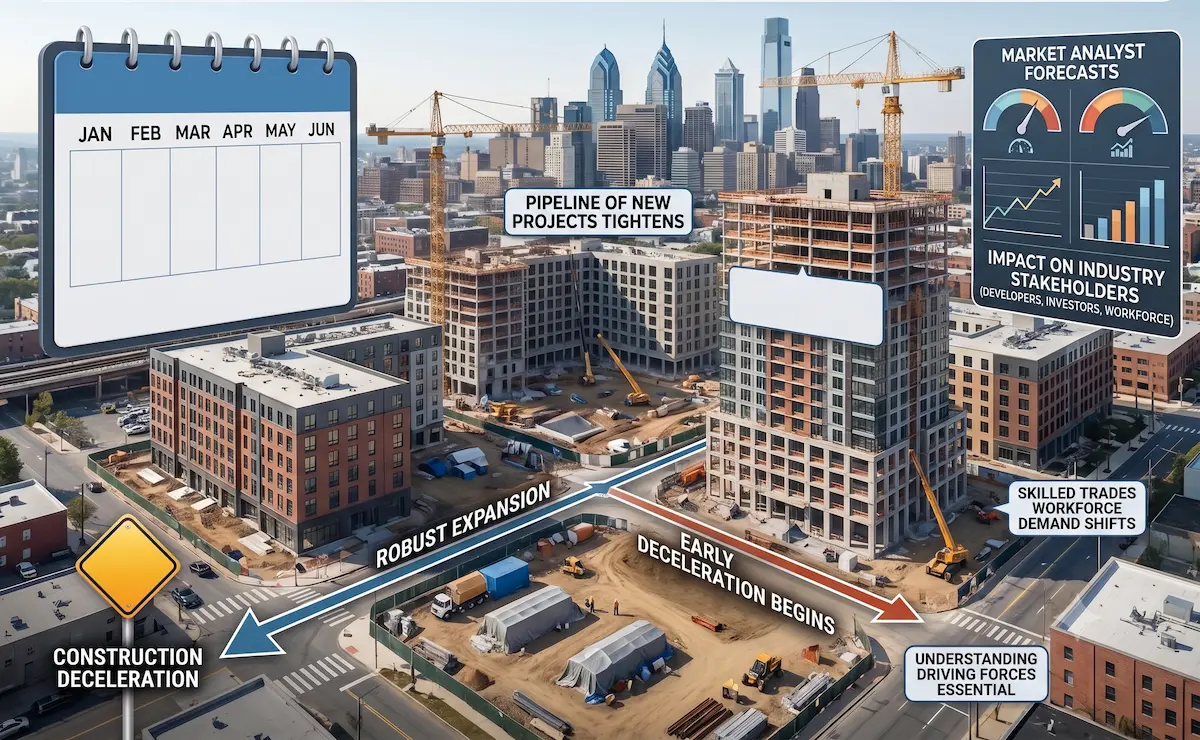
The Philadelphia real estate landscape is undergoing a significant transition as market analysts adjust their forecasts for the coming years. After a period of robust expansion, the sector is bracing for a deceleration in new inventory hitting the market. Recent data indicates that Philadelphia multifamily construction deliveries 2026 are projected to slow down at the start of the year. This shift marks a pivotal moment for developers, investors, and the skilled trades workforce that powers the city’s growth. As the pipeline of new projects tightens, understanding the driving forces behind this slowdown becomes essential for industry stakeholders preparing for the next phase of the market cycle.
Analyzing the Slowdown in Philadelphia Multifamily Construction Deliveries 2026
The projection for a slowdown in early 2026 is not an anomaly but rather the result of economic conditions set in motion 24 to 36 months prior. Multifamily construction typically has a long lead time; therefore, the delivery numbers for 2026 reflect the financing and ground-breaking activities of 2024 and early 2025. During this period, the industry faced a “perfect storm” of rising interest rates, elevated material costs, and stringent lending standards.
According to industry reports, the volume of new construction starts in the Greater Philadelphia area has seen a marked contraction over the last year. As financing costs surged, many developers chose to pause or cancel planned projects rather than lock in prohibitively expensive construction loans. Consequently, the pipeline feeding into 2026 has narrowed. Data from major real estate firms suggests that while 2024 and 2025 saw a wave of completions from projects initiated during the low-interest era of 2021-2022, the carry-over into 2026 is significantly thinner.
This cooling off period suggests that Philadelphia multifamily construction deliveries 2026 will likely be dominated by a smaller cohort of high-end, luxury developments and essential workforce housing projects that secured early capital. The market is shifting from a volume-driven expansion to a stabilization phase where absorption rates will attempt to catch up with the recent influx of inventory.
Economic Headwinds: The Impact of Financing and Labor
To understand the trajectory of construction deliveries, one must look at the economic barriers currently stifling new ground-breakings. The primary driver of the projected slowdown is the cost of capital. With the Federal Reserve maintaining higher interest rates to combat inflation, the cost of borrowing for commercial real estate has soared. For multifamily developers, whose profit margins rely heavily on the spread between construction costs and rental income, these rates have rendered many projects financially unfeasible.
Furthermore, the construction labor shortage continues to plague the region. Philadelphia, like many major metropolitan areas, is facing a gap between the demand for skilled labor and the available workforce. This shortage extends to every trade, from excavation to finishing. The scarcity of labor drives up wages and extends project timelines, causing further delays. When projects drag on, completion dates are pushed back, sometimes causing delays that bleed into subsequent fiscal years, further skewing delivery projections for early 2026.
Additionally, the rising cost of insurance—specifically builder’s risk and property insurance—has added another layer of expense. Developers in flood-prone or high-density zones are seeing premiums skyrocket, which acts as a deterrent for new developments. These compounding financial pressures have forced a more cautious approach, resulting in the lean delivery schedule anticipated for 2026. For further reading on national construction trends impacting local markets, the National Association of Home Builders provides regular updates on financing and labor statistics.
Specific Regional Impacts
While the overall trend is a slowdown, the impact will not be evenly distributed across the Philadelphia metropolitan area. Neighborhoods that saw an oversaturation of high-rise apartments, such as Center City and University City, may experience the sharpest decline in new deliveries as developers wait for absorption rates to improve. Conversely, suburban submarkets with growing demand for walkable urban living, such as King of Prussia or Conshohocken, may see a more stable, albeit slower, delivery schedule as developers pivot to lower-density, stick-built communities which often have shorter development cycles.
The Ripple Effect on Skilled Trades and Drywall Demand
For the readers of PhillyTradeExperts.com, the most critical aspect of this construction slowdown is its direct impact on the trades. A reduction in project completions translates directly to reduced demand for skilled labor. As Philadelphia multifamily construction deliveries 2026 decelerate, subcontractors and specialty trades will need to adjust their strategies to maintain revenue.
The drywall industry, in particular, serves as a reliable bellwether for the health of multifamily construction. Drywall is one of the final major stages of interior construction; high delivery numbers always correlate with high demand for hanging, finishing, and taping. With fewer units coming online, the demand for drywall materials and installation labor is expected to soften in the first half of 2026. Contractors who relied heavily on large-scale multifamily contracts for new builds may find themselves facing a more competitive bidding environment with tighter margins.
However, this slowdown in new builds does not necessarily mean a complete standstill for the trades. The focus often shifts during these periods. While new construction may dip, the demand for renovation, retrofitting, and turnover services in existing multifamily stock remains consistent. Property management firms and owners of older Class B and C assets often accelerate renovation cycles during market downturns to retain tenants. Skilled tradespeople who can pivot from new builds to interior renovations and “re-tenant” improvements will be better positioned to weather the reduction in Philadelphia multifamily construction deliveries 2026.
Opportunities in Adaptive Reuse
Another area where trades may find opportunity is in adaptive reuse projects. As new construction financing becomes difficult, developers are increasingly looking at converting existing commercial structures—such as obsolete office buildings—into residential units. These projects are incredibly complex and require specialized trade skills, particularly in MEP (Mechanical, Electrical, Plumbing) and structural modifications. For drywall contractors, these projects often present unique challenges involving framing around existing infrastructure and soundproofing between units, potentially offsetting the volume loss from new ground-up projects.
Conclusion: Navigating the Correction
The projected dip in activity is a market correction following years of aggressive growth. While the immediate outlook for early 2026 suggests a cooling period, it also
Leave a Reply