
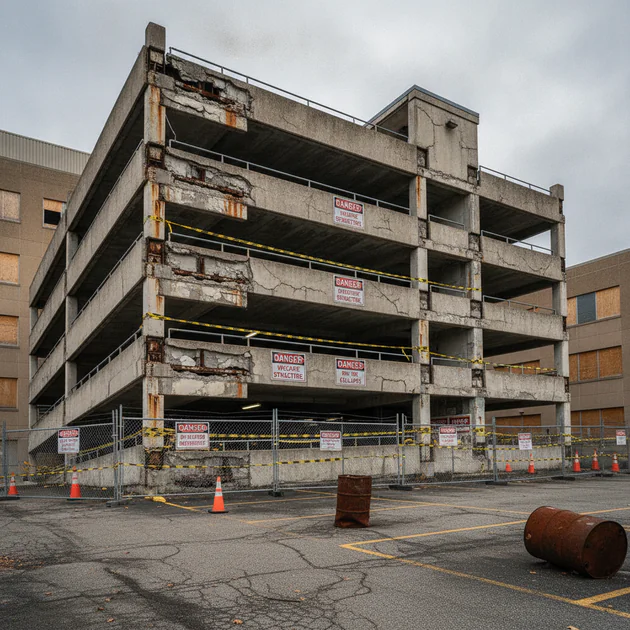
The construction landscape in the greater Philadelphia region is on high alert. A recent, urgent development has sent a shockwave through the industry: a major hospital parking garage in New Jersey has been declared structurally unsafe and closed indefinitely. The root cause? Critical failures within its precast concrete components, drawing alarming parallels to the catastrophic 2023 garage collapse at the Children’s Hospital of Philadelphia (CHOP). This incident involving an NJ precast structure is not an isolated event; it’s a stark warning sign that demands immediate attention from every developer, engineer, and facility manager in our area.
For professionals in Philadelphia’s trade and construction sectors, this news hits close to home. The materials, designs, and construction practices used in this New Jersey garage are mirrored in countless structures throughout our own city and the surrounding suburbs. The declaration of this NJ precast garage as unsafe moves the conversation from theoretical risk to tangible, present danger. It underscores a potential systemic vulnerability in a common building method that has been a staple of regional construction for decades.
At Philadelphia Trade Experts, we believe that knowledge is the first line of defense. This comprehensive analysis will dissect the failure in New Jersey, compare it directly to the lessons learned from the CHOP incident, and provide a clear, actionable blueprint for assessing the risk within your own portfolio. We will explore the technical details of precast concrete defects, the implications for building safety regulations, and the proactive steps you must take to ensure the structural integrity of your assets and the safety of the public.
Table of Contents
- The Anatomy of the Crisis: What Went Wrong at the New Jersey Hospital Garage?
- Déjà Vu: Drawing Parallels to the CHOP Collapse
- Understanding Precast Concrete Defects: A Deeper Dive for Industry Leaders
- The Ripple Effect: Implications for Philadelphia’s Built Environment
- Proactive Measures: A Blueprint for Ensuring Structural Integrity
- Frequently Asked Questions About NJ Precast Safety and Structural Concerns
The Anatomy of the Crisis: What Went Wrong at the New Jersey Hospital Garage?
While full engineering reports are pending, initial findings from the New Jersey site paint a troubling picture. The multi-story garage, a vital piece of infrastructure for a busy medical center, was constructed using precast concrete—a method prized for its speed and cost-efficiency. However, the very elements that make it attractive can also hide significant vulnerabilities if not manufactured, designed, and installed with exacting precision. The current crisis with this NJ precast facility appears to stem from a combination of long-term degradation and potential latent defects.
Engineers on site have flagged several critical areas of concern, which together compromise the garage’s overall structural integrity concerns. These observations serve as a checklist of what to look for in similar structures across our region. The primary issues identified include:
- Failure of Connections: The most severe issue appears to be the degradation of steel connections between precast components, such as double-tee beams and load-bearing columns. Water intrusion over many years, exacerbated by road salts and freeze-thaw cycles, has likely led to significant corrosion, weakening these critical load-transfer points.
- Concrete Spalling and Delamination: Large sections of concrete have reportedly spalled—or broken away—from the underside of beams and decks. This is often a tell-tale sign of corroding rebar within the concrete, which expands and exerts immense pressure, causing the concrete cover to fail.
- Compromised Topping Slabs: The concrete topping slab, which forms the driving surface, is showing extensive cracking and deterioration. This allows for further water penetration, accelerating the decay of the underlying precast double-tees and their connections.
- Bearing Pad Degradation: The neoprene or elastomeric bearing pads that sit between precast elements, allowing for thermal expansion and contraction, have become brittle and compressed, leading to improper load distribution and point-loading stresses that the structure was not designed to handle.
This particular NJ precast garage was built in an era when certain details, like stainless steel connections or robust waterproofing systems, were often value-engineered out of projects to reduce upfront costs. Unfortunately, that approach has a finite lifespan, and the bill is now coming due. The closure represents a classic case of deferred maintenance and latent vulnerabilities converging to create an imminent safety hazard, triggering this urgent hospital garage safety alert.
Déjà Vu: Drawing Parallels to the CHOP Collapse
For anyone in the Philadelphia construction industry, the news from New Jersey is eerily familiar. The partial collapse of the CHOP parking garage in 2023 was a watershed moment that forced a regional reckoning with the safety of our aging precast structures. The similarities between the two events are too significant to ignore and suggest a pattern of failure that every asset owner must understand.
The CHOP collapse was attributed to the failure of connections supporting precast concrete double-tee beams—the same type of components under scrutiny in the New Jersey incident. In both cases, the failure mechanism appears to be a slow, insidious process of deterioration rather than a singular event like an earthquake or impact. This process involves water infiltration, corrosion of steel reinforcement and connections, and the gradual loss of structural capacity until a component can no longer support its load.
This pattern highlights a critical vulnerability in many precast structures built between the 1970s and early 2000s. During this period, the focus was on the strength of the individual precast pieces, with less emphasis on the longevity and durability of the connections that hold the entire system together. The use of standard carbon steel for connectors, insufficient waterproofing, and inadequate drainage design created a perfect storm for premature aging. The NJ precast garage alert confirms that the CHOP incident was not a fluke; it was a warning.
Understanding Precast Concrete Defects: A Deeper Dive for Industry Leaders
To effectively manage the risks associated with precast structures, it’s essential to understand where and how defects can originate. Precast concrete defects are not always immediately apparent and can be introduced at any stage of a component’s lifecycle. A proactive approach requires a holistic understanding of these potential failure points.
The journey of a precast component from plant to final placement is complex, with quality control being paramount at every step. Here is a breakdown of the lifecycle and where problems can arise:
- Design and Engineering Phase: The foundation of safety is a robust design. Oversights in this phase, such as underestimating load requirements, failing to account for deicing salt exposure, or designing inadequate drainage, can bake vulnerabilities into a structure from day one. Proper concrete construction standards must be rigorously applied.
- Manufacturing and Fabrication: The quality of a precast piece is determined at the plant. Potential defects include an improper concrete mix, incorrect placement of reinforcing steel or prestressing strands, and insufficient curing times. The Precast/Prestressed Concrete Institute (PCI) provides certification programs to ensure plants meet high-quality standards, but not all producers are certified.
- Transportation and Handling: Precast elements are large and heavy. Improper lifting, support, or transportation can induce hairline cracks or stresses that may not be visible but can become pathways for water intrusion later.
- On-Site Installation: This is one of the most critical phases. Errors here can have immediate and long-term consequences. Common installation defects include misaligned components, improperly welded connections, poorly mixed or installed grout at connection points, and damaged bearing pads. These installation errors are a primary concern for the NJ precast garage in question.
- In-Service Degradation: Once the structure is in use, it is subjected to environmental loads. Freeze-thaw cycles, water penetration, exposure to chlorides (road salt), and carbonation all work to degrade the concrete and corrode the steel reinforcement over time. A lack of preventative maintenance dramatically accelerates this process.
Understanding these stages is crucial for any firm conducting a structural engineering assessment. An investigator must think like a detective, tracing the evidence of distress back to its likely origin point to develop an effective remediation strategy. For more information on industry standards, the American Concrete Institute (ACI) is an essential resource for all construction professionals.
The Ripple Effect: Implications for Philadelphia’s Built Environment
The closure of a single NJ precast garage is more than a local news story; it’s a critical data point with far-reaching implications for the entire Philadelphia metropolitan area. Our city and its suburbs are home to hundreds, if not thousands, of parking garages, office buildings, warehouses, and stadiums built with similar precast concrete systems during the same era. Each of these structures could be harboring similar latent defects.
The immediate consequence is a heightened sense of urgency around building safety regulations. We can anticipate that municipal authorities in Philadelphia and surrounding counties will begin to mandate more stringent and frequent inspections for precast structures, particularly parking garages. This will likely evolve from a general visual inspection to requiring detailed assessments by licensed structural engineers, including potential non-destructive testing (NDT).
For building owners and property managers, the financial and legal ramifications are significant.
- Increased Liability: A failure to act in the face of these known risks could be deemed negligent. The legal liability for any future incident will be immense for owners who have not performed due diligence.
- Rising Insurance Costs: Insurance carriers are taking note of these failures. Expect premiums for property and liability insurance to increase for owners of aging precast structures. Underwriters may soon require a clean bill of health from a structural engineer as a condition of coverage.
- Capital Expenditure Planning: The cost of comprehensive inspections, and more importantly, the potential repairs, must now be factored into capital expenditure budgets. A “run to failure” maintenance approach is no longer fiscally or ethically defensible.
The Philadelphia trade community must shift from a reactive to a proactive mindset. The time to assess your assets is now, not after a notice from the city or, worse, after a failure. Our team at Philadelphia Trade Experts offers comprehensive structural integrity assessments designed to identify these hidden risks before they become catastrophic failures.
A Blueprint for Ensuring Structural Integrity
In light of the NJ precast garage alert, waiting is not an option. A systematic, proactive approach is the only responsible path forward. Here is a five-step blueprint that facility managers, building owners, and construction firms can implement to safeguard their assets and ensure public safety.
Step 1: Inventory and Triage Your Portfolio
Begin by creating a detailed inventory of all structures you own or manage that incorporate precast concrete. For each building, document its age, original construction plans (if available), and any known history of repairs or issues. Triage this list based on risk factors: prioritize older structures (pre-2000), those with high exposure to deicing salts (like parking garages), and any that are already showing visible signs of distress.
Step 2: Conduct Thorough Visual Inspections
Train your maintenance staff or hire a professional to conduct a detailed visual inspection. This goes beyond a simple walk-through. Look specifically for:
- Rust Stains (Efflorescence): Brown or orange stains weeping from cracks are a dead giveaway of underlying rebar corrosion.
- Spalling or Flaking Concrete: Pay close attention to the underside of beams and decks, especially over joints and at bearing points.
- Cracking Patterns: Map and document any cracks. Wide, structural cracks are an immediate red flag.
- Water Intrusion and Ponding: Note any areas where water is leaking through the structure or ponding on surfaces, as these are points of accelerated deterioration.
Step 3: Engage a Qualified Structural Engineer
If your visual inspection reveals any of the red flags above, or if the structure is over 25 years old, it is imperative to engage a licensed structural engineer with experience in precast concrete assessment. They will perform a hands-on evaluation, which may include sounding the concrete with a hammer to detect delamination that isn’t yet visible.
Step 4: Consider Nondestructive Testing (NDT)
For a more in-depth analysis, an engineer may recommend NDT methods. Techniques like ground-penetrating radar (GPR) can map out rebar and identify voids, while impact-echo testing can assess concrete thickness and integrity. In some cases, small core samples may be taken for laboratory analysis to test for chloride content and compressive strength.
Step 5: Develop and Execute a Repair and Maintenance Plan
Based on the engineering assessment, you will receive a report detailing the structure’s condition and a list of recommended actions. This will form the basis of a prioritized repair and long-term maintenance plan. Addressing minor issues like sealing cracks and repairing drainage systems early can prevent multi-million dollar structural repairs later. For advanced solutions, it’s wise to explore our guide on modern concrete repair techniques.
Frequently Asked Questions About NJ Precast Safety and Structural Concerns
What are the immediate warning signs of precast concrete failure?
Immediate warning signs requiring urgent attention include sudden, wide cracks appearing; pieces of concrete falling from the structure; and noticeable sagging or deflection of beams or floor slabs. Less urgent but still critical signs are rust stains bleeding through concrete, widespread spalling (flaking), and water actively leaking through ceilings and walls. Any of these warrant an immediate call to a structural engineer.
How often should a precast concrete parking garage be inspected?
Best practices are evolving. A general recommendation is a quick visual inspection by maintenance staff quarterly, a detailed visual inspection by a qualified person annually, and a comprehensive, hands-on assessment by a licensed structural engineer every 3 to 5 years. The frequency should increase for older structures, those in harsh climates with heavy salt use, or any building that has a known history of issues.
Who is liable when a precast structure fails?
Liability can be complex and may be shared among multiple parties. The building owner has the primary responsibility for maintaining a safe structure. However, if the failure is traced back to original design flaws, the architect or engineer of record could be held liable. If it’s due to manufacturing defects, the precast producer could be at fault. A forensic engineering investigation is typically required to determine the chain of causation and assign liability.
Are newer precast structures safer than older ones?
Generally, yes. Modern concrete construction standards and material science have advanced significantly. Newer designs often include better waterproofing, more robust drainage systems, and corrosion-resistant materials like galvanized or stainless steel for connections. Furthermore, quality control in certified fabrication plants is more rigorous today. However, proper installation and ongoing maintenance remain critical for all structures, regardless of age.
What makes parking garages particularly vulnerable to these types of issues?
Parking garages face a uniquely harsh environment. They are typically open to the elements, subjecting them to rain, snow, and extreme temperature swings. Most importantly, vehicles bring in water and deicing salts in the winter. These chlorides are highly corrosive to the steel reinforcement within the concrete, dramatically accelerating deterioration. This constant exposure makes them one of the most at-risk types of precast structures.
A Critical Juncture for Regional Construction Safety
The closure of the NJ precast hospital garage is not a distant problem; it is a direct and urgent wake-up call for the entire Philadelphia construction and real estate community. It confirms that the CHOP collapse was not an anomaly but a symptom of a larger, systemic issue with our aging infrastructure. The era of passive observation is over. Proactive, expert-led assessment is no longer just a best practice—it is an essential, non-negotiable responsibility for ensuring public safety and protecting the value of your assets.
The parallels between these incidents create a clear mandate for action. Owners and managers of precast concrete structures must move beyond routine maintenance and invest in comprehensive structural evaluations to identify and mitigate hidden risks. The potential cost of inaction—in terms of financial liability, business disruption, and human life—is simply too high to ignore.
The landscape of building safety is changing rapidly. Don’t be caught unprepared. Contact Philadelphia Trade Experts today to discuss a proactive assessment of your structures and subscribe to our newsletter to stay updated on critical regional precast concrete safety alerts. Let us help you navigate these challenges with confidence and expertise.
Leave a Reply