
Table of Contents
- What Exactly Are Insulated Concrete Forms (ICFs) and Why the Sudden Buzz in Philly?
- The Core Benefit: How Philly ICFs Create a Hyper-Efficient Building Envelope
- Beyond Energy Savings: The Compounding Advantages of Building with ICFs in Philadelphia
- Navigating the Practicalities: Costs, Labor, and Local Supply for Philly ICFs
- The Future of Philadelphia Sustainable Construction is Concrete
- Frequently Asked Questions About Philly ICFs
Across Philadelphia, from the rowhomes of South Philly to the sprawling new developments in the suburbs, a quiet revolution is taking shape within the very walls of new construction projects. While the city’s skyline continues to evolve, the most significant changes are often unseen, focused on performance, resilience, and long-term value. For builders, developers, and architects, the pressure is mounting. Volatile energy costs, increasingly stringent building codes, and a client base that is more educated than ever on sustainability are forcing a re-evaluation of traditional building methods. The old way of doing things is no longer enough. This is where Philly ICFs are making a profound impact.
Insulated Concrete Forms (ICFs) represent a paradigm shift in construction, moving beyond simple wood frames to create structures that are fundamentally more robust and efficient. This isn’t just another trend; it’s a strategic response to the modern challenges of the Philadelphia construction market. For professionals in the trade, understanding and adopting this technology is becoming less of an option and more of a necessity to stay competitive and deliver the superior product clients now demand. The conversation has moved from “what are we building?” to “how are we building it for the future?”
This comprehensive guide from Philadelphia Trade Experts will delve deep into the world of Philly ICFs. We’ll explore why this method is gaining rapid traction, break down the science behind its incredible energy performance, and address the practical questions of cost, labor, and implementation on a local level. Whether you’re a seasoned developer or a custom home builder, this article will provide the actionable insights you need to leverage the power of ICFs for your next project, ensuring you’re building not just for today, but for decades to come.
What Exactly Are Insulated Concrete Forms (ICFs) and Why the Sudden Buzz in Philly?
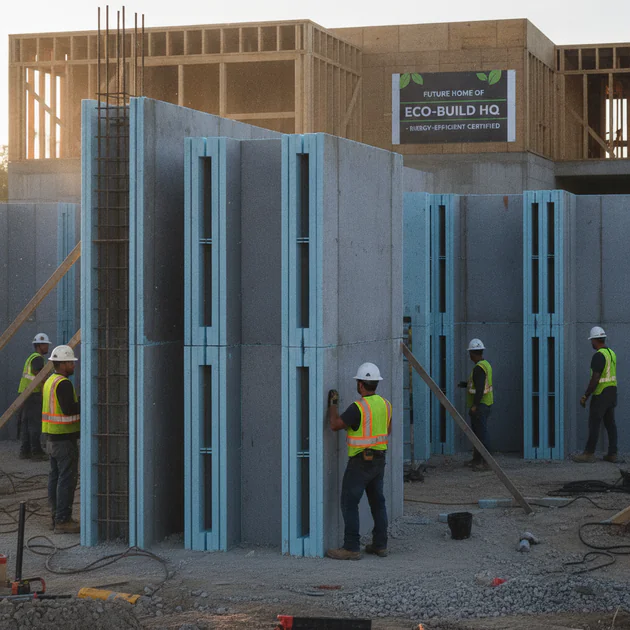
At its core, an Insulated Concrete Form (ICF) system is brilliantly simple. Imagine large, hollow blocks made of high-density foam, similar in shape to oversized LEGO bricks. These blocks are stacked on-site to form the exterior walls of a building. Steel reinforcement (rebar) is placed inside the hollow core, and then concrete is poured in. The result is a monolithic, steel-reinforced concrete wall sandwiched between two continuous layers of high-performance insulation. The foam forms stay in place permanently, providing the insulation for the life of the building.
Let’s break down the components:
- Expanded Polystyrene (EPS) Foam Panels: These are the two outer layers of the block. The EPS is lightweight, inert, non-toxic, and provides the primary thermal insulation. It also serves as the form for the wet concrete.
- Plastic Webbing: Embedded within the foam panels are high-strength plastic webs. These webs hold the two foam panels together at a specific distance (determining the thickness of the concrete core) and provide a secure attachment point for drywall on the inside and exterior finishes like brick, stucco, or siding on the outside.
- Reinforced Concrete Core: The solid concrete core provides the structure’s strength, durability, and a significant portion of its thermal performance through mass.
So, why is this technology, which has been around for decades, suddenly becoming a go-to for energy efficient building in Philly? The convergence of several key local and national factors has created the perfect environment for the rise of Philly ICFs.
First, Philadelphia’s climate zone and evolving energy codes demand higher performance from building envelopes. The city experiences both hot, humid summers and cold, damp winters, placing a heavy load on HVAC systems. Traditional wood-frame construction, with its thermal bridging through studs and potential for air leakage, struggles to meet modern R-value and airtightness standards without complex and costly additions. ICFs meet and often dramatically exceed these requirements right out of the box.
Second, there is a growing market demand for Philadelphia sustainable construction. Clients, both commercial and residential, are increasingly aware of their carbon footprint and the long-term cost of energy. They are actively seeking homes and buildings that are not only cheaper to operate but also healthier and more comfortable to live in. Building with ICFs is a powerful marketing tool and a tangible demonstration of a commitment to quality and green building principles, helping projects qualify for certifications like LEED and Passive House.
The Core Benefit: How Philly ICFs Create a Hyper-Efficient Building Envelope
The term “building envelope” refers to the physical barrier between the conditioned interior of a building and the unconditioned exterior. An effective envelope controls the flow of heat, air, and moisture. This is where ICF construction truly outshines conventional methods. It’s not just about one feature; it’s about how three critical elements work together to create a nearly perfect system.
1. Superior R-Value and Continuous Insulation
R-value measures a material’s resistance to heat flow. A higher R-value means better insulation. A standard ICF wall has a stated R-value of R-22 to R-25, but its real-world performance is even higher. This is because, unlike a wood-frame wall, the insulation is continuous, with no thermal bridges. In a stick-built wall, every wood stud (which has a low R-value of around R-4) creates a path for heat to escape, reducing the effective R-value of the entire wall assembly by as much as 20-30%.
- Typical 2×6 Wood-Frame Wall: Stated R-19 insulation in the cavity, but an effective whole-wall R-value of R-14 to R-16 due to thermal bridging.
- Standard ICF Wall: Stated R-22 insulation, with an effective whole-wall R-value of R-22+ because there are no thermal breaks.
2. The Power of Thermal Mass
This is the secret weapon of Philly ICFs and a concept often overlooked in wood-frame construction. Thermal mass is the ability of a material to absorb, store, and later release significant amounts of heat. The solid concrete core of an ICF wall acts like a thermal battery. In the winter, it absorbs heat from the sun during the day and slowly releases it back into the home at night, reducing the load on the furnace. In the summer, it absorbs the day’s heat, keeping the interior cool, and releases it to the cooler night air. This “flywheel effect” stabilizes indoor temperatures, drastically reducing the peaks and valleys of HVAC usage and leading to energy savings of 30-50% or more on heating and cooling, according to studies by the U.S. Department of Energy.

3. Unmatched Airtightness
Air leakage can account for a huge portion of a building’s energy loss. Uncontrolled air movement carries heat, moisture, and pollutants with it. An ICF wall, being a solid, monolithic structure of concrete and continuous foam, forms an incredibly effective air barrier. Blower door tests, which measure a home’s airtightness, consistently show that ICF homes are 50-75% tighter than their wood-frame counterparts. This means fewer drafts, better indoor air quality, and significantly lower energy consumption, as your conditioned air stays exactly where you want it: inside.
When you combine high R-value, massive thermal mass, and extreme airtightness, you get a building envelope that performs on a completely different level. This is the fundamental reason why Philly ICFs are the superior choice for anyone serious about energy efficiency.
Beyond Energy Savings: The Compounding Advantages of Building with ICFs in Philadelphia
While the energy efficiency of ICFs is the primary driver of their adoption, the benefits extend far beyond lower utility bills. For Philadelphia builders, these additional advantages create a compelling value proposition that resonates with a wide range of clients, from homeowners to commercial developers.
Unmatched Durability, Safety, and Resilience
The core of an ICF wall is steel-reinforced concrete, one of the strongest and most durable building materials known. This provides a level of resilience that wood-frame construction simply cannot match.
- Disaster Resistance: ICF structures can be engineered to withstand hurricane-force winds of over 200 mph and offer significantly greater protection against seismic events and impacts from debris.
- Fire Safety: This is a critical factor in dense urban areas like Philadelphia. ICF walls typically have a fire-resistance rating of 4 hours or more, compared to the 15-60 minutes for a typical wood-frame wall. This provides invaluable time for occupants to escape and for first responders to arrive, potentially saving lives and limiting property damage.
A Sanctuary of Silence: Superior Soundproofing
Life in and around a bustling city comes with noise—traffic, trains, neighbors, and construction. ICF walls provide an exceptional acoustic barrier. They typically achieve a Sound Transmission Class (STC) rating of 50 or higher, meaning that loud speech is inaudible. For comparison, a standard wood-frame wall has an STC rating of around 36-38. This makes ICFs an ideal solution for multi-family housing, townhomes, and any building located near a source of noise pollution, creating a peaceful and quiet interior environment that is a major selling point.
Healthier Indoor Air Quality
The Philly green building movement isn’t just about energy; it’s also about creating healthier spaces for people. The solid, continuous nature of ICF walls contributes significantly to this goal.
- No Mold or Mildew: The EPS foam and concrete are inert materials that do not support the growth of mold, mildew, or rot.
- Reduced Allergens and Pollutants: The superior airtightness of the ICF envelope prevents dust, pollen, and other outdoor pollutants from infiltrating the building, leading to cleaner indoor air.
- No Off-Gassing: The materials used in ICFs are free from the volatile organic compounds (VOCs) that can be found in some treated wood products and adhesives.
These compounding benefits—safety, quiet, and health—transform a building from a simple structure into a high-performance sanctuary. When presenting a project to a client, these are the powerful, tangible quality-of-life improvements that justify the investment in a superior building system like Philly ICFs.
Navigating the Practicalities: Costs, Labor, and Local Supply for Philly ICFs
For any construction professional, innovation is only valuable if it’s practical to implement. The most common questions we hear at Philadelphia Trade Experts revolve around the real-world cost and logistics of switching to ICFs. Let’s tackle these head-on.
A Clear-Eyed Look at Costs and ROI
It’s true that the upfront material and labor cost for an ICF wall system can be slightly higher than for a basic wood-framed structure—typically in the range of 3-7% of the total project cost. However, focusing solely on this initial number is shortsighted. A proper cost analysis reveals significant savings and a compelling return on investment.
- Reduced HVAC Sizing: The hyper-efficient envelope of an ICF building allows for the installation of a significantly smaller, and therefore less expensive, HVAC system. This can offset a large portion of the initial wall cost.
- Faster Construction Cycle: ICF construction combines six steps into one: structure, insulation, air barrier, vapor barrier, and furring strips for interior and exterior finishes. An experienced crew can stack ICF walls much faster than a framing crew can build, sheath, and insulate a comparable wall, leading to savings on labor and financing costs.
- Lower Long-Term Operating Costs: This is the big one. Energy savings of 30-50% or more on heating and cooling translate into thousands of dollars back in the owner’s pocket over the life of the building.
- Reduced Insurance Premiums: Many insurance carriers offer discounts for the superior fire and wind resistance of ICF structures.
- Increased Property Value: A home or building that is more comfortable, quieter, safer, and cheaper to operate is inherently more valuable and easier to sell.
Labor, Training, and the Philadelphia Market
There is a learning curve for crews transitioning from wood framing to ICFs. However, the system is designed to be builder-friendly. Most major ICF manufacturers offer comprehensive training and certification programs, many of which are available locally in the Philadelphia area. Investing in training for your crew is a small price to pay for the efficiency gains you’ll see on future projects. As your team’s experience grows, installation speed increases dramatically. For specialized projects, or for your first few builds, partnering with an experienced team can be invaluable. Philadelphia Trade Experts offers consulting and installation services to help ensure your project goes smoothly.
Local Supply Chain Accessibility
Concerns about sourcing materials are valid, but rest assured, the supply chain for Philly ICFs is robust. All major North American ICF brands, such as Nudura, Logix, Fox Blocks, and Amvic, have well-established distributors serving the entire Philadelphia metropolitan area and the wider Delaware Valley. Materials can be readily ordered and delivered to your job site, just like any other building product.
The Future of Philadelphia Sustainable Construction is Concrete
Looking ahead, the forces driving the adoption of ICFs are only going to intensify. As Philadelphia continues to push for greater energy efficiency and sustainability, building codes will become even more stringent. You can learn more about the latest updates on our post about Philly’s 2024 building code changes. Building methods that barely meet today’s standards will be obsolete tomorrow. Adopting Philly ICFs is not just about meeting the code; it’s about building far beyond it, future-proofing your projects and your business.
ICF construction is a key enabler for achieving the highest levels of building performance, including Passive House and Net-Zero Energy standards. These ultra-efficient buildings are the future of construction, and ICFs provide the foundational building envelope needed to make them a reality. The Philadelphia sustainable construction community is increasingly recognizing that the inherent properties of ICFs—thermal mass, continuous insulation, and airtightness—are essential tools in the quest for a greener built environment.

Furthermore, the conversation around sustainable concrete itself is evolving. Innovations in concrete technology are leading to lower-carbon mixes and practices that enhance the material’s environmental profile. As detailed by industry leaders like the National Ready Mixed Concrete Association (NRMCA), concrete’s longevity, resilience, and thermal properties make it a cornerstone of sustainable design when used intelligently. By building with ICFs, you are creating structures that will stand for centuries, requiring less energy, less maintenance, and fewer resources over their incredibly long lifespan. This is the definition of true sustainability.
Frequently Asked Questions About Philly ICFs
Can I use ICFs for renovations or just new construction?
While ICFs are most commonly used for the entire building shell in new construction, they are also an excellent solution for additions and foundations. For an addition, ICFs provide a simple way to create a highly insulated and structurally sound new space. In renovations, they are often used to build a new, well-insulated foundation under an existing structure. Using them for interior retrofits is less common due to the thickness of the walls.
How do ICF walls compare to traditional Concrete Masonry Units (CMUs) or block walls?
ICF walls are superior to traditional CMU (cinder block) walls in almost every way. A standard CMU wall has very poor insulation (around R-2) and is prone to air and moisture leakage through its many mortar joints. To achieve the same energy performance as a standard ICF wall, a CMU wall would require multiple additional layers of interior and exterior insulation and air/vapor barriers, adding significant cost and complexity to the project. Philly ICFs provide structure and high-performance insulation in a single, integrated system.
What are the R-value requirements in Philadelphia, and how do ICFs meet them?
Philadelphia falls into Climate Zone 4A. Current energy codes typically require around R-20 for continuous insulation or R-13 + R-5 for cavity/sheathing combinations on above-grade walls. A standard ICF wall, with a continuous R-value of R-22 or higher, easily exceeds these minimum requirements. More importantly, the superior airtightness and thermal mass of ICFs result in a building that performs far better than a code-minimum wood-frame structure, leading to greater real-world energy savings.
Is it difficult to run electrical and plumbing in ICF walls?
No, it’s actually quite straightforward. After the concrete is poured, channels for wiring and small-diameter plumbing are easily cut into the interior EPS foam layer using a hot knife or electric router. The foam is typically 2.5 inches thick, providing ample space. Electrical boxes are then attached to the plastic webs embedded in the foam. This process is often faster and creates less mess than drilling through dozens of wood studs. For larger plumbing stacks, a chase or bulkhead is typically designed into the wall plan from the start.
Build for the Future of Philadelphia with ICFs
The evidence is clear: for builders and developers in Philadelphia, the shift towards high-performance construction is undeniable. Insulated Concrete Forms are no longer a niche product but a mainstream solution for creating structures that deliver unparalleled energy efficiency, safety, comfort, and long-term value. From the immediate savings on HVAC systems to the lifelong reduction in utility bills, Philly ICFs offer a powerful return on investment for both the builder and the end-user.
By embracing this technology, you are not just erecting a building; you are crafting a resilient, sustainable asset that is prepared for the future of energy costs and climate challenges. You are meeting the growing demand for Philly green building head-on and setting a new standard for quality in the local market.
Ready to explore the powerful benefits of building with ICFs for your next Philadelphia project? The learning curve is manageable, the supply chain is local, and the advantages are too significant to ignore. Contact the team at Philadelphia Trade Experts today to discuss your needs and see how we can help you build smarter, stronger, and more efficiently.
Leave a Reply