
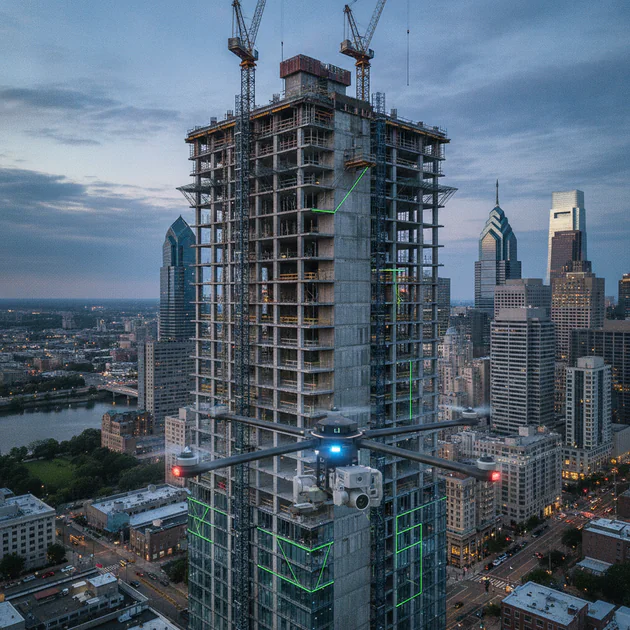
The iconic Philadelphia skyline, a testament to our city’s relentless ambition and growth, is constantly evolving. From the towering Comcast Technology Center to the new developments rising in University City and along the Delaware River, each new structure pushes the boundaries of engineering and design. However, this vertical progress comes with inherent risks, particularly for the skilled tradespeople working at dizzying heights. For decades, ensuring safety on these complex sites has relied on manual inspections that are often dangerous, time-consuming, and incomplete. But a technological revolution is taking place high above the streets of Philly, fundamentally changing how we protect our workforce. The integration of advanced AI Drones is setting a new, unprecedented standard for Philadelphia construction safety, turning hazardous tasks into data-driven, preventative strategies.
At Philadelphia Trade Experts, we’ve seen firsthand how this powerful combination of aerial robotics and artificial intelligence is moving beyond a niche concept to become an essential tool for proactive risk management. These intelligent systems are not just capturing breathtaking photos; they are performing comprehensive safety audits with a level of detail and efficiency that was previously unimaginable. By leveraging AI Drones, project managers and safety officers can identify potential hazards—from minuscule structural cracks to improperly secured equipment—before they escalate into costly delays or tragic accidents. This article will explore the profound impact of this technology on high-rise construction in our city, detailing how it works, its tangible benefits, and what Philadelphia firms need to know to stay ahead of the curve.
Table of Contents
- The Old Way vs. The New: Why Traditional Inspections Fall Short
- The Power Couple: How AI Drones Work in Tandem for Superior Safety
- Key Applications of AI Drones in Philadelphia’s High-Rise Projects
- The Tangible Benefits: A Clear ROI for Philadelphia Construction Firms
- Navigating the Future: Challenges and Considerations for Adoption
- Frequently Asked Questions About AI Drones in Construction
The Old Way vs. The New: Why Traditional Inspections Fall Short
To truly appreciate the leap forward that AI construction technology represents, we must first understand the limitations of the methods it’s replacing. For generations, inspecting the facade and structure of a high-rise building under construction was a high-risk, labor-intensive endeavor. It relied on brave individuals using equipment that, while necessary, introduced its own set of dangers.
Traditional inspection methods typically included:
- Scaffolding: Erecting extensive scaffolding around a building is incredibly slow and expensive. It obstructs work, poses a significant fall risk during assembly and disassembly, and can even damage the very facade it’s meant to help inspect.
- Man-Lifts and Cranes: While faster than scaffolding, using boom lifts or suspended baskets still places inspectors in potentially precarious positions. Their reach is limited, they can be unstable in windy conditions common around Philly’s skyscrapers, and they require significant ground-level coordination, disrupting site logistics.
- Rope Access: This method, involving inspectors rappelling down a building’s face, requires highly specialized and physically demanding skills. It exposes individuals to significant fall hazards and relies entirely on the inspector’s line of sight, which can be inconsistent.
Beyond the direct physical risks, these legacy methods share a set of critical drawbacks that impact the entire project’s health. They are inherently subjective, with the quality of the inspection dependent on the individual’s experience and diligence on a given day. The data collected is often a series of photographs and handwritten notes, which are difficult to analyze comprehensively and track over time. This process is not only slow, leading to project delays, but it also creates blind spots. An inspector can’t see everything, and subtle signs of material fatigue or water intrusion can easily be missed, only to become major structural problems later. The era of accepting these limitations is over; drone safety inspections offer a demonstrably better path forward.
The Power Couple: How AI Drones Work in Tandem for Superior Safety
The term “AI Drones” isn’t just a buzzword; it describes a symbiotic relationship between two powerful technologies. The drone acts as the advanced data-gathering platform—the “eyes in the sky”—while the AI serves as the tireless, hyper-aware analyst—the “brain of the operation.” Together, they create a closed-loop system for site hazard identification that is both comprehensive and predictive.
The Drone: Advanced Aerial Surveying
Modern construction drones are far more than simple quadcopters with cameras. They are sophisticated platforms equipped with a suite of sensors designed for high-fidelity data capture:
- High-Resolution RGB Cameras: Capturing tens of thousands of detailed images that can be stitched together to create photorealistic 3D models, or “digital twins,” of the entire site.
- LiDAR (Light Detection and Ranging): Using laser pulses to create incredibly precise point-cloud models, measuring distances and capturing geometry with millimeter-level accuracy.
- Thermal Sensors: Detecting temperature variations across a building’s surface, which can indicate hidden moisture, insulation gaps, or electrical system faults.
A drone can autonomously fly a pre-programmed route, ensuring consistent and complete coverage of a building’s envelope in a fraction of the time it would take a human team. This rapid data collection minimizes disruption and provides a complete snapshot of the site’s condition at a specific moment in time.
The AI: From Data to Actionable Intelligence
The raw data collected by the drone is massive and overwhelming for a human to analyze effectively. This is where artificial intelligence takes center stage. The AI platform, often cloud-based, processes the terabytes of data to extract meaningful insights:
- Object Recognition: The AI is trained on vast datasets of construction images to recognize specific objects and conditions. It can automatically identify cracks, spalling concrete, water stains, unsecured tools near an edge, or workers not wearing proper Personal Protective Equipment (PPE).
- Change Detection: By comparing scans from different days or weeks, the AI can automatically flag changes over time. It can track the propagation of a crack, monitor the curing of concrete, or verify that a previously identified hazard has been corrected.
- Predictive Analytics: This is the most transformative aspect. By analyzing subtle patterns and historical data, the AI can move beyond simple detection to prediction. It can flag areas with a high probability of future water intrusion or identify structural stress points before they become visible failures, forming the core of modern construction risk management Philly.
- Automated Reporting: Instead of manually compiling notes, the system generates detailed, geolocated reports. A safety manager receives a dashboard highlighting the most critical issues, complete with images, precise locations, and severity ratings, allowing them to prioritize action immediately.
Key Applications of AI Drones in Philadelphia’s High-Rise Projects
The versatility of high-rise safety drones allows them to be deployed across the entire project lifecycle, from groundbreaking to final handover. For Philadelphia’s unique construction environment, which often involves tight urban spaces and historic preservation considerations, these applications are particularly valuable.
- Facade and Structural Integrity Scans: This is a primary use case. The drone can perform a detailed scan of the entire building envelope, and the AI can flag issues like cracks in welds, loose masonry, sealant failures, and signs of corrosion. This proactive approach prevents falling debris and ensures long-term structural health.
- Real-Time Site Safety Monitoring: Drones can conduct regular autonomous flights to monitor compliance with safety protocols. The AI can automatically detect if guardrails are missing, if materials are stored too close to an edge, or if unauthorized personnel are in a restricted area. This provides safety managers with a constant overview of site conditions, ensuring better worker protection.
- Quality Assurance and Progress Tracking: By comparing the 3D models generated by the drone to the project’s BIM (Building Information Modeling) files, the AI can verify that work is being installed according to spec. This helps catch costly construction errors early and provides stakeholders with an accurate, visual record of project progress.
- Thermal Imaging for MEP and Envelope Integrity: Before the walls are closed up, a thermal drone can inspect for faults in HVAC systems, electrical hotspots, or gaps in insulation. This ensures the building is energy-efficient and prevents moisture-related problems like mold down the line.
- Regulatory Compliance and Documentation: The data captured by AI Drones creates an unimpeachable digital record. This is invaluable for demonstrating compliance with OSHA regulations and for resolving disputes or insurance claims. Having a detailed, time-stamped visual history of the entire project is a powerful risk mitigation tool.
The Tangible Benefits: A Clear ROI for Philadelphia Construction Firms
Adopting any new technology requires a clear business case. For AI Drones, the return on investment is compelling and multifaceted, extending far beyond just the safety department. Philadelphia firms that embrace this technology gain a significant competitive advantage.
- Dramatically Enhanced Safety: This is the most important benefit. By removing humans from dangerous inspection tasks, you drastically reduce the risk of falls, the leading cause of fatalities in construction. According to a study published by the IEEE, automated drone-based monitoring can significantly improve hazard detection rates. This commitment to worker protection improves morale and can lead to a stronger safety culture on site.
- Unprecedented Speed and Efficiency: An inspection that would take a team on a swing stage two weeks to complete can be done by a drone in a single afternoon. This acceleration means faster project timelines, reduced equipment rental costs, and the ability to conduct more frequent checks, leading to a continuously monitored and safer site.
- Significant Cost Reductions: The savings are substantial. Firms save on labor, scaffolding and lift rentals, and, most importantly, insurance premiums. A safer site with fewer incidents leads to a lower Experience Modification Rate (EMR), directly reducing insurance costs. Furthermore, catching defects early prevents expensive rework later in the project. For more on managing these costs, see our guide on Philadelphia Safety Consulting.
- Superior Data for Better Decisions: Project managers are no longer working with subjective notes and a handful of photos. They have access to objective, comprehensive, and measurable data. This allows for more informed decision-making, better resource allocation, and a more accurate understanding of the project’s health, which is the cornerstone of effective construction risk management Philly.
- Enhanced Client and Stakeholder Communication: Being able to provide clients with a detailed 3D model of their project or a time-lapse video of progress builds trust and transparency. It demonstrates a commitment to quality, safety, and cutting-edge practices, strengthening your firm’s reputation in the competitive Philadelphia market.
Navigating the Future: Challenges and Considerations for Adoption
While the benefits are clear, integrating AI Drones into construction workflows is not without its challenges. A strategic approach is necessary for successful implementation.
Regulatory Hurdles: The skies are regulated airspace. All commercial drone operations must comply with FAA rules, including Part 107 regulations for pilots. Philadelphia may also have specific local ordinances regarding drone flights in dense urban areas. It’s crucial to work with certified and insured pilots who understand the legal landscape.
Data Management and Security: A single drone flight can generate hundreds of gigabytes of sensitive project data. Firms need robust IT infrastructure to store, process, and secure this information from cyber threats. Choosing a reputable AI software partner with strong security protocols is essential.
Initial Investment and Training: High-end drones, sensors, and AI software represent a significant upfront investment. Furthermore, staff must be trained to interpret the data and integrate it into their existing project management systems. However, many firms are opting to partner with specialized service providers to avoid these capital expenditures and leverage existing expertise.
Weather and Site Limitations: Drones cannot operate safely in high winds, heavy rain, or snow. Flight plans must account for Philadelphia’s variable weather. Additionally, very dense urban canyons can sometimes interfere with GPS signals, requiring pilots with advanced manual flying skills.
Despite these considerations, the momentum is undeniable. The technology is rapidly becoming more accessible and user-friendly. As firms gain experience, these challenges are being effectively managed, paving the way for widespread adoption. Keeping up with these changes is key, as we discuss in our analysis of current Philly construction trends.
Frequently Asked Questions About AI Drones in Construction
What are the key FAA regulations for using drones on a Philly construction site?
For most commercial use on a construction site, you must follow the FAA’s Part 107 rules. This requires the drone pilot to have a Remote Pilot Certificate, the drone to be registered, and operations to be conducted during daylight hours, below 400 feet, and within the pilot’s visual line of sight. Flying in the controlled airspace around Philadelphia International Airport (PHL) or Northeast Philadelphia Airport (PNE) requires special authorization through the FAA’s LAANC system.
How does AI actually identify a safety hazard from a drone image?
The AI uses a process called computer vision, specifically a type of machine learning called a convolutional neural network (CNN). The AI is “trained” by being fed millions of images that have been labeled by humans. For example, it sees thousands of pictures of “cracks,” “unsecured rebar,” and “workers with hard hats.” Over time, it learns to recognize the visual patterns associated with these labels. When it analyzes a new image from your site, it can identify and flag these trained objects with a high degree of accuracy.
Is the initial cost of implementing AI drones worth it for smaller projects?
While the upfront cost of purchasing enterprise-level equipment can be high, the ROI can be significant even for smaller projects. The cost of a single safety incident, in terms of medical bills, project delays, and OSHA fines, can easily exceed the cost of a drone program. Many companies start by hiring a third-party drone service provider (DSP) for specific tasks, like facade inspections, which allows them to reap the benefits without the capital investment.
Can AI drones completely replace human safety inspectors?
No, and that’s not their purpose. AI Drones are a powerful tool to augment the capabilities of human experts, not replace them. The technology handles the dangerous, repetitive, and data-intensive work of inspection. This frees up the human safety manager to focus on higher-level tasks: analyzing the AI-generated reports, developing mitigation strategies, training workers, and using their experience and judgment to oversee the overall safety culture on site. It’s a human-machine collaboration.
Conclusion: Building a Safer Philadelphia, From the Sky Down
The Philadelphia skyline is reaching new heights, and our safety standards must rise with it. The integration of AI Drones is the most significant leap forward in construction risk management Philly has seen in a generation. This technology is actively transforming high-risk jobs into data-driven, strategic operations. It empowers project managers with a near-omniscient view of their sites, enabling them to identify and mitigate hazards with unprecedented speed and accuracy.
From ensuring the structural integrity of a new skyscraper’s curtain wall to verifying that every worker on the 40th floor is tied off correctly, AI Drones are providing an invaluable layer of oversight. The benefits are clear and compelling: drastically improved worker safety, accelerated project timelines, significant cost savings, and a wealth of objective data for better decision-making. This is no longer a futuristic concept; it is a practical, powerful tool available today. For construction firms in Philadelphia, embracing this technology isn’t just about gaining a competitive edge—it’s about upholding our most important responsibility: ensuring every worker goes home safe at the end of the day.
Curious about the future of construction tech? See how AI and drones are enhancing safety in Philadelphia. Contact Philadelphia Trade Experts today to learn how we can help you integrate this transformative technology into your next project.
Leave a Reply