
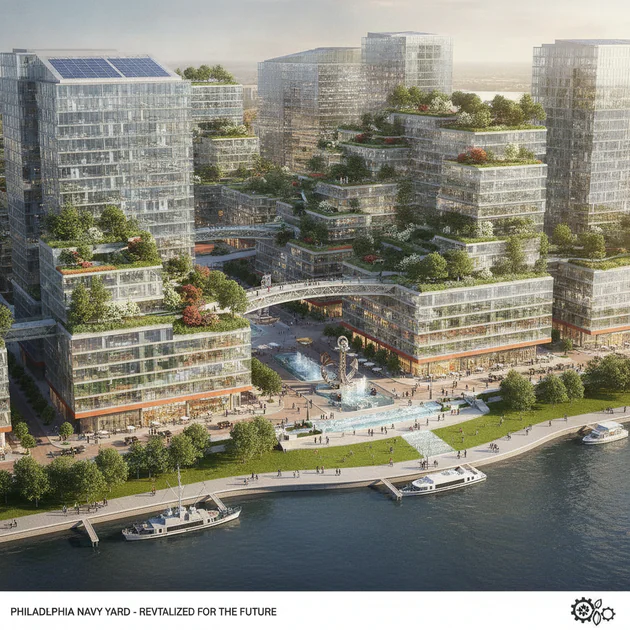
For decades, the Philadelphia Navy Yard has stood as a symbol of the city’s industrial prowess and maritime heritage. Now, this sprawling 1,200-acre campus on the banks of the Delaware River is on the verge of its most ambitious chapter yet. A landmark revitalization project, spearheaded by a dynamic public-private partnership, is set to redefine the area as a vibrant, mixed-use urban neighborhood. By 2026, this historic site will not only expand its role as a premier business and research hub but will also welcome its first-ever residential community, fundamentally transforming its identity and its impact on the city.
This monumental undertaking represents more than just new buildings; it’s a blueprint for Philadelphia’s future. The plan integrates cutting-edge commercial spaces, modern residential living, and extensive public amenities, creating a fully realized live-work-play environment. For professionals in Philadelphia’s construction, engineering, and trade industries, this project is a generational opportunity. It signals a wave of complex, high-value contracts and a chance to contribute to a legacy project that will shape the city’s economic and social landscape for years to come.
At Philadelphia Trade Experts, we understand that navigating such a large-scale development requires deep local knowledge and forward-looking insights. This comprehensive guide is designed for industry leaders like you. We will dissect the master plan, explore the technical challenges of the infrastructure upgrades, analyze the economic opportunities, and provide a clear-eyed view of what the Navy Yard’s evolution means for your business and the city at large.
Table of Contents
- From Shipyard to Innovation Hub: The Navy Yard’s Storied Past and Ambitious Future
- The Master Plan Unveiled: A Deep Dive into Commercial and Residential Development
- Critical Infrastructure Upgrades: The Backbone of the New Navy Yard
- Economic Impact and Opportunities for Philadelphia’s Trade Professionals
- Navigating the Challenges and Looking Ahead to 2026
- Frequently Asked Questions About the Navy Yard Development
From Shipyard to Innovation Hub: The Navy Yard’s Storied Past and Ambitious Future
To fully grasp the significance of the 2026 revitalization, one must understand the rich history of the Philadelphia Navy Yard. Established in 1801, it was the nation’s first naval shipyard, a powerhouse of maritime manufacturing that built and serviced ships through two World Wars. For nearly two centuries, the sounds of industry echoed across its docks and workshops, employing tens of thousands of Philadelphians and cementing the city’s role in American history. When the shipyard was officially decommissioned in 1996, it left behind a vast industrial landscape and a question: what’s next?
The answer began to take shape under the stewardship of PIDC, Philadelphia’s public-private economic development corporation. Over the past two decades, PIDC has masterfully managed the Navy Yard’s transition from a shuttered military base into a dynamic business campus. Home to over 150 companies and 15,000 employees, it has become a magnet for innovation, particularly in life sciences, advanced manufacturing, and corporate headquarters, with major tenants like Urban Outfitters and GSK.
However, the campus has largely remained a 9-to-5 destination. The current revitalization plan, a collaboration between PIDC and the master development team Ensemble/Mosaic, is designed to change that. This next phase is not just an expansion but a fundamental evolution. The goal is to create a true 24/7 neighborhood. The “why now?” is driven by a convergence of factors: the maturity of the existing business campus, strong market demand for life science and R&D facilities, and a growing desire for integrated urban environments where people can live, work, and recreate in one place. This project leverages the site’s unique waterfront location, historic architecture, and existing economic engine to build a community unlike any other in Philadelphia.
The Master Plan Unveiled: A Deep Dive into Commercial and Residential Development
The core of the Philadelphia Navy Yard development is an ambitious master plan that envisions millions of square feet of new construction. This mixed-use redevelopment in Philadelphia is meticulously designed to foster collaboration, community, and economic vitality. The plan is divided into distinct but interconnected districts, each with its own character, blending historic preservation with bold new architecture from leading architectural design firms in Philadelphia and beyond.
Philly Navy Yard Commercial Space: A Hub for 21st-Century Industries
The commercial component of the revitalization is designed to supercharge the Navy Yard’s reputation as a center for innovation. The plan calls for approximately 3 million square feet of new life sciences, research and development, office, and light manufacturing space. This isn’t just about adding more offices; it’s about creating purpose-built ecosystems for specific high-growth sectors.
The focus on life sciences is particularly strategic, capitalizing on Philadelphia’s status as a “Cellicon Valley.” The new labs and research facilities will be state-of-the-art, designed to accommodate the specialized needs of biotech, pharmaceutical, and cell and gene therapy companies. This creates a powerful synergy with the existing academic and medical institutions in the region. Beyond life sciences, the development will cater to a diverse range of tenants.
- Life Sciences & R&D: Flexible, high-tech lab and research facilities designed to attract both startups and established global firms.
- Creative & Tech Offices: Modern, collaborative workspaces aimed at technology companies, design firms, and creative agencies.
- Advanced Manufacturing: Spaces tailored for next-generation manufacturing, robotics, and industrial technology.
- Retail & Hospitality: Ground-floor retail, restaurants, cafes, and a new hotel to service the growing population of workers and residents, creating a vibrant street-level experience.
Navy Yard Residential Development: A New Waterfront Community
Perhaps the most transformative element of the plan is the introduction of the Navy Yard residential development. For the first time, people will be able to call the Navy Yard home. The initial phase targets the development of approximately 4,000 residential units, including apartments and townhomes, housed in a variety of building types. This move is critical to creating the 24/7 environment envisioned by planners.
The residential offerings will be designed to appeal to a wide demographic, from young professionals working at the Navy Yard to families seeking a unique urban living experience. The architecture will complement the area’s industrial heritage while offering modern amenities and stunning waterfront views. The planning emphasizes community and connectivity, with a focus on:
- Public Green Spaces: Extensive parks, waterfront trails, and recreational areas will be woven throughout the residential districts, providing residents with direct access to nature.
- Walkability and Transit: The neighborhood is being designed with a “15-minute city” concept in mind, where daily needs—groceries, cafes, transit—are all within a short walk.
- Community Amenities: Plans include resident-exclusive fitness centers, community gathering spaces, and integrated retail that serves the daily needs of the population.
This residential component is the key to activating the Navy Yard after business hours, supporting the new retail and restaurant scene, and creating a truly dynamic and resilient urban district.
Critical Infrastructure Upgrades: The Backbone of the New Navy Yard
Building a new city-within-a-city requires more than just vertical construction; it demands a comprehensive Navy Yard infrastructure upgrade. The success of the entire 2026 vision hinges on the robust, resilient, and sustainable foundation being laid beneath the ground and along the new streetscapes. This foundational work is one of the most complex aspects of the project, addressing decades of industrial use while preparing for a new generation of residents and workers.
A significant challenge is the necessary site remediation at the Navy Yard. As a former naval shipyard, the land requires careful environmental assessment and cleanup to ensure it is safe for commercial and residential use. This process involves soil testing, contaminant removal, and adherence to strict state and federal environmental regulations, representing a major investment in the long-term health of the site.
Beyond remediation, the project involves a complete overhaul and expansion of essential utilities and transportation networks. The development team is working closely with city agencies and utility providers to execute a multi-faceted infrastructure plan. The key priorities include:
- Utility Modernization: Upgrading and expanding the electrical grid, water and sewer lines, and high-speed fiber optic networks to support the increased demand from thousands of new residents and advanced commercial labs.
- Transportation & Transit: Creating a new, more connected street grid within the development area. This includes building new roads, improving existing ones, and integrating multimodal transit options like enhanced bus service, dedicated bike lanes, and exploring a potential extension of the Broad Street Line.
- Stormwater Management & Resiliency: Implementing advanced green infrastructure to manage stormwater runoff, a critical consideration for a waterfront site. This includes bioswales, green roofs, and permeable pavements to mitigate flooding and protect the Delaware River watershed. You can learn more about PIDC’s comprehensive approach on their official master plan page.
- Public Realm & Green Space: Investing heavily in creating a high-quality public realm. This means wide sidewalks, extensive tree planting, new public parks, and a continuous waterfront trail system that connects the new districts and provides a major public amenity for all of Philadelphia.
These infrastructure projects represent significant contract opportunities for civil engineers, excavation companies, utility contractors, and landscape architects. They are the essential, unseen work that will enable the Navy Yard’s vibrant future.
Economic Impact and Opportunities for Philadelphia’s Trade Professionals
The revitalization of the Navy Yard is projected to be a powerful engine for economic growth in Philadelphia. The sheer scale of the project—billions in new investment—will create a ripple effect across the regional economy, generating thousands of jobs and substantial business opportunities, particularly for the construction and trade sectors.
The construction phase alone is expected to create an estimated 12,000 to 15,000 jobs. This includes opportunities for a vast array of skilled trades, from electricians and plumbers to steelworkers and heavy equipment operators. For local firms, this represents a pipeline of high-value projects for years to come. Philadelphia Trade Experts anticipates strong demand for specialized services, especially in areas like laboratory construction, sustainable building practices, and complex utility installations. Explore how our team can support your role in these large-scale commercial projects.
This development is a prime example of successful public-private partnerships in Philly. The collaboration between PIDC and Ensemble/Mosaic provides the financial stability and long-term vision needed to execute a project of this magnitude. This partnership model ensures that the development aligns with the city’s broader economic goals, such as promoting local and minority-owned business participation.
Looking at the bigger picture, this project is a cornerstone of the major Philadelphia construction projects for 2026 and beyond. It solidifies the city’s position as a leader in life sciences and provides a compelling new urban neighborhood that will help attract and retain top talent. The long-term economic benefits are even more significant. Once completed, the new commercial and residential spaces will support an estimated 10,000 permanent jobs and generate millions in new annual tax revenue for the city and state, funding public services for all Philadelphians.
Navigating the Challenges and Looking Ahead to 2026
While the vision for the Navy Yard is bold and inspiring, its execution is not without challenges. Large-scale urban redevelopment projects of this nature are inherently complex, requiring careful navigation of economic, logistical, and regulatory hurdles. For construction professionals, understanding these potential obstacles is key to successful project bidding and execution.
Economic headwinds, including inflation, interest rate fluctuations, and potential shifts in market demand, could impact project timelines and financing. Supply chain disruptions, a persistent issue in recent years, may affect the availability and cost of critical building materials. Furthermore, the regional construction market faces a skilled labor shortage, making workforce development and retention a top priority for every contractor involved in the Navy Yard’s build-out.
The regulatory landscape is another critical area. The project requires a multitude of permits and approvals from various city and state agencies. The entitlement process for a development of this size is intricate, and maintaining a collaborative relationship with community stakeholders and regulatory bodies is essential for keeping the project on track. As industry experts, staying informed on these trends is crucial. We regularly analyze these factors on our Philadelphia construction trends blog.
Despite these challenges, the long-term outlook remains overwhelmingly positive. The phased approach to the development allows for flexibility and adaptation to changing market conditions. The strong commitment from both public and private partners provides a stable foundation to weather potential difficulties. As reported by outlets like The Philadelphia Inquirer, the momentum is strong. The 2026 milestone is not an end date but rather the beginning of a new era for the Navy Yard, setting the stage for decades of continued growth and evolution.
FAQ: Your Questions About the Navy Yard Development Answered
What is the timeline for the Navy Yard residential development?
The first phase of residential construction is slated to break ground in the near future, with the first units expected to be delivered and available by 2025-2026. The full build-out of all 4,000 planned units will occur in phases over the next decade, with development density and timing adjusted based on market demand. This phased approach ensures a steady and sustainable integration of the new residential community into the existing campus.
What types of businesses are being targeted for the new commercial spaces?
The primary focus for the new commercial space is the life sciences sector, including cell and gene therapy, biotech, and pharmaceutical R&D. However, the plan is designed to attract a diverse mix of innovative companies. This includes technology firms, creative agencies, advanced manufacturers, and corporate headquarters. The goal is to build on the Navy Yard’s existing tenant base and create a dynamic ecosystem where different industries can collaborate.
How is the project addressing sustainability and environmental concerns?
Sustainability is a core principle of the master plan. All new buildings will be designed to high-performance green building standards, such as LEED. The infrastructure plan heavily incorporates green stormwater management techniques to protect the riverfront environment. Furthermore, the project includes extensive site remediation to clean up legacy industrial contamination. The emphasis on walkability and public transit is also a key sustainability feature, aiming to reduce reliance on single-occupancy vehicles.
Will there be public access and green spaces in the new development?
Absolutely. A key goal of the revitalization is to make the Navy Yard more accessible and enjoyable for all Philadelphians. The plan includes the creation of several new public parks, plazas, and a continuous waterfront trail that will be open to the public. The ground floors of many new buildings will feature retail and restaurants, creating an active and welcoming street-level experience for residents, workers, and visitors alike.
The Future is Being Built at the Navy Yard
The 2026 revitalization of the Philadelphia Navy Yard is more than just another construction project; it is a transformative moment for our city. It represents a bold investment in our economic future, a commitment to innovative urban design, and the creation of a brand-new waterfront neighborhood on historic ground. The fusion of cutting-edge commercial space with vibrant residential life will create a powerful new center of gravity for Philadelphia.
For the leaders of Philadelphia’s construction and trade industries, this is a call to action. The opportunities are immense, but so are the complexities. Success will require expertise, collaboration, and a deep understanding of the project’s ambitious goals. From advanced infrastructure and site remediation to the construction of state-of-the-art labs and modern homes, the skills of our region’s tradespeople will be on full display.
The next few years will be a period of intense activity and groundbreaking progress. As this historic site evolves, it will not only honor its past but build a resilient and prosperous future for all of Philadelphia. The foundation is being laid for a community that will thrive for generations, and the work starts now.
What’s next for the Navy Yard? Explore the ambitious revitalization plans shaping Philadelphia’s waterfront.
Leave a Reply